Category: room

  • Sitting Room Gallery Wall: 20 Ideas, Layouts & Hanging Tips

    Sitting Room Gallery Wall: 20 Ideas, Layouts & Hanging Tips

    A blank wall in the sitting room can feel like an unanswered question. A single print often looks lost, but a well-planned gallery of art, photos and objects turns that wall into the most personal part of the home.

    The difference between a gallery that looks curated and one that looks cluttered comes down to a few decisions: the right wall, a clear layout, consistent spacing, and a sensible hanging height.

    This guide walks you through everything you need to create a sitting room gallery you’ll love. You’ll find seven layouts, the key measurements, how to choose art and frames, a step-by-step hanging plan and 20 ideas to borrow.

    What Is a Sitting Room Gallery?

    A sitting room gallery, often called a gallery wall, is a group of framed artwork, photographs, mirrors or objects arranged together on one wall so they read as a single display.

    It can be tidy and symmetrical or relaxed and eclectic. It can hold family photos, travel prints, children’s drawings, calligraphy, vintage finds or original paintings.

    “Sitting room” is the term used across the UK, Pakistan and India for the main living room or guest room. Because this is where guests are welcomed, the gallery often becomes the first thing visitors notice.

    Why a Gallery Works So Well

    A gallery wall adds personality in a way few other decor pieces can. It tells the story of the people who live in the home.

    It’s also flexible. You can start with a few frames and add to it over time, or change prints with the seasons.

    A sitting room gallery also solves the problem of scale. Several smaller pieces grouped together can fill a large wall that would need an expensive oversized artwork otherwise.

    Choosing the Right Wall

    Not every wall suits a gallery. The right spot makes a sitting room gallery feel like part of the room rather than an afterthought, so look for these spots first.

    Above the sofa. The most common and reliable choice. The sofa anchors the display, and the gallery becomes the room’s focal point.

    The wall you see first. The wall facing the entrance is seen by everyone who walks in, which makes it a natural showcase.

    Beside a fireplace or TV. A gallery can balance a TV or fireplace, especially if it flanks one side or surrounds it.

    Staircase or hallway walls next to the sitting room. These extend the gallery and lead the eye into the room.

    A reading corner. A small gallery above an armchair creates a cozy, defined nook.

    Avoid walls broken up by switches, vents,s and doors, or walls that get harsh direct sun, which can fade prints over time.

    7 Gallery Layouts to Choose From

    The layout sets the mood of the whole display. Choose one before you buy frames, because the layout decides how many frames you need and what sizes your sitting room gallery will use.

    Grid

    Identical frames hung in neat rows and columns with equal spacing. It’s calm, modern and ideal for a series of prints or black-and-white photographs.

    Salon style

    A dense, eclectic mix of sizes, frames and art, hung close together, sometimes floor to ceiling. It feels collected and full of character, perfect for traditional and maximalist rooms.

    Centered anchor

    One large piece in the middle, with smaller pieces arranged around it. The anchor gives the eye a starting point and keeps the mix organized.

    Linear or horizontal line

    Frames aligned along a single top or bottom edge, or a central line. It’s tidy and works well above long sofas or sideboards.

    Picture ledge

    One or two narrow shelves hold leaning frames. You can rearrange pieces without new holes, which makes it great for renters and people who like change.

    Asymmetrical cluster

    An organic arrangement without strict lines, held together by consistent spacing and a shared color palette.

    Wraparound or corner gallery

    The gallery turns a corner or wraps around a door or window. It’s bold and works well in rooms with limited wall space.

    Spacing and Height Rules

    These numbers keep a sitting room gallery looking balanced. Save them for hanging day.

    RuleMeasurement
    Gap between frames5–8 cm (2–3 in)
    Gap above sofa or sideboard15–25 cm (6–10 in)
    Center of the whole galleryAbout 145 cm (57 in) from the floor
    Gallery width above furnitureAbout two-thirds of the furniture width
    Margin from wall edges and ceilingAt least 30 cm (12 in)
    Grid layout spacingExactly equal on all sides

    In sitting rooms people mostly sit, so hanging slightly lower than standard eye level often looks better. A gap of roughly one hand-width above the sofa back is a simple guide.

    Keep the spacing consistent. Even if the frames are very different, equal gaps make the gallery feel deliberate.

    Choosing Art and Frames

    What you hang matters as much as how you hang it.

    Pick a theme or palette

    A shared color palette ties together very different pieces. Pull one or two colors from your cushions, rug or curtains and repeat them through the art.

    You can also choose a theme: travel, botanicals, family, calligraphy, architecture,e or abstract art.

    Mix sizes thoughtfully

    Combine one or two larger pieces with medium and small ones. Too many small frames look busy; mixing sizes draws the eye across the display.

    Decide on frames

    Matching frames, all black, white, gold or natural wood, create a calm and cohesive look. Mixed frames feel more eclectic and collected. If you mix, keep one element consistent, such as the color of the mounts.

    Use mounts (mats)

    White or off-white mounts give art breathing room and make inexpensive prints look more polished.

    Add objects

    Mirrors, woven baskets, plates, wall hangings and small sculptures add texture and break up rows of rectangles.

    Frame and Print Size Guide

    Standard sizes make shopping and reframing easier. These common sizes mix well in most galleries.
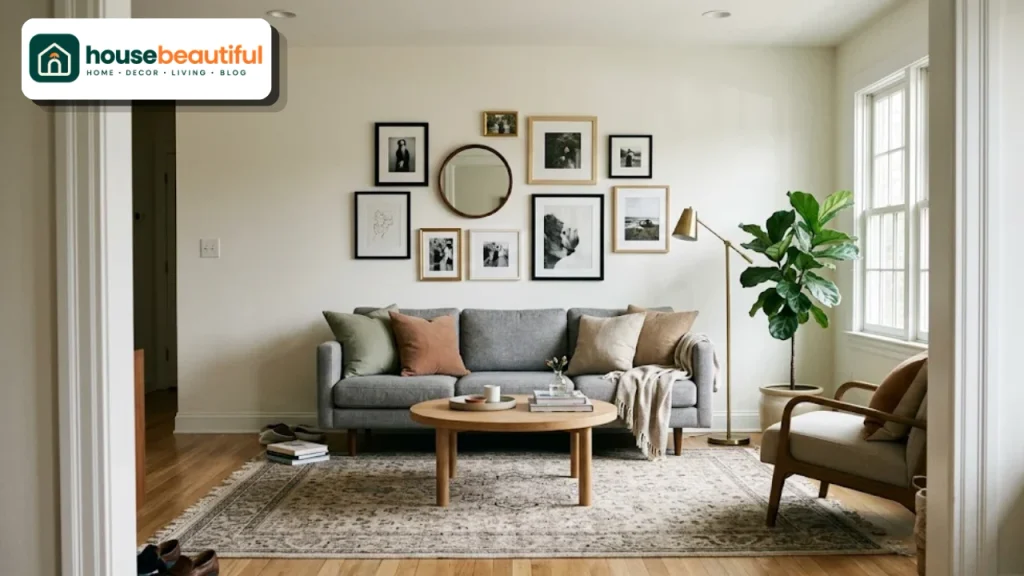
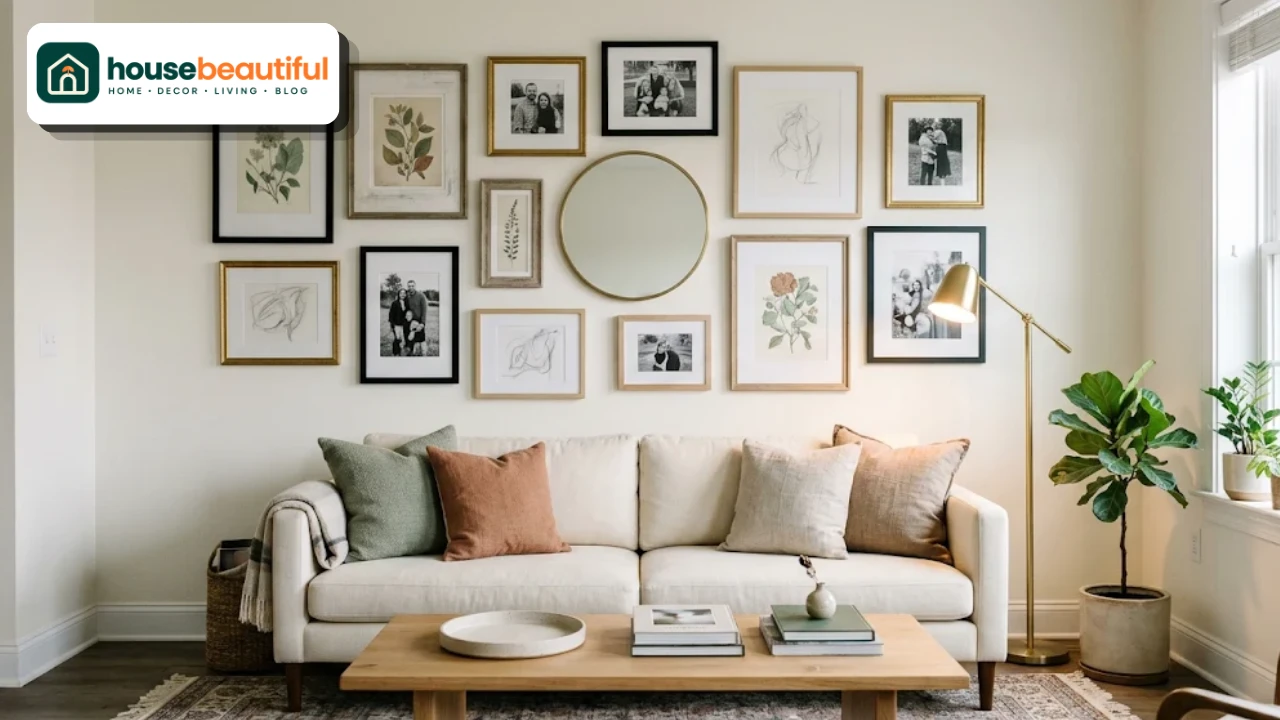
    Gallery wall hung above a sofa as the sitting room focal point
    Role in the galleryCommon sizes
    Anchor piece50 x 70 cm, 60 x 90 cm, 70 x 100 cm
    Medium pieces30 x 40 cm, 29.7 x 42 cm (A3), 40 x 50 cm
    Small pieces13 x 18 cm, 20 x 25 cm, 21 x 29.7 cm (A4)
    Square accents30 x 30 cm, 50 x 50 cm

    A good mix for a medium wall is one anchor, three or four medium frames and four to six small ones.

    Tools You’ll Need

    Gather these before you start so hanging day goes smoothly:

    Tape measure and pencil

    Spirit level (or a level app on your phone)

    Kraft paper or newspaper and scissors for templates

    Painter’s tape

    Hammer and picture hooks rated for each frame’s weight

    Wall plugs and screws for heavy pieces or hollow walls

    Adhesive bumpers to keep frames straight

    A helper to hold frames and check from a distance

    How to Hang a Sitting Room Gallery Step by Step

    Follow these steps to get a professional result without filling the wall with extra holes. Taking your time here is what makes a sitting room gallery look polished rather than improvised.

    Measure the wall and furniture. Note the width of the sofa or sideboard below and mark the available area.

    Gather your pieces. Collect everything you want to include before deciding on the final layout.

    Lay it out on the floor. Arrange the frames on the floor in the same footprint as the wall space. Move them until the balance feels right, and take a photo.

    Make paper templates. Trace each frame onto kraft paper, cut it out,t and mark where the hanging hook sits.

    Tape templates to the wall. Use painter’s tape to stick the templates up, then step back and adjust. Live with it for a day if you can.

    Start with the anchor piece. Hang the largest or central piece first, then work outward.

    Nail through the templates. Hammer the hook through the marked point on each template, then tear the paper away.

    Level and adjust. Use a spirit level on each frame and small adhesive pads on the back corners to stop them tilting.

    20 Sitting Room Gallery Ideas

    Use these ideas as a starting point and adapt them to your space.

    Black-and-white family photos

    Printing family photos in black and white makes them look timeless and stops a mix of old and new photos from clashing.

    Botanical prints

    Framed leaves, flowers and plant illustrations bring a fresh, natural feel and suit almost every style.

    Calligraphy and Islamic art

    Framed calligraphy, Quranic verses or geometric Islamic patterns create an elegant, meaningful gallery, especially in a formal sitting room.

    Travel memories

    Combine maps, postcards, tickets and photos from trips you’ve taken. It makes a great conversation starter for guests.

    Children’s artwork

    Frame your children’s drawings in matching frames to make them look like a real art collection.

    Vintage finds

    Old paintings, antique mirrors and secondhand frames from markets create a collected, characterful gallery.

    Monochrome prints

    A gallery limited to black, white and grey feels calm and modern and suits minimal rooms.

    Bold color pop

    Choose prints in one bright accent color, such as mustard, emerald or coral, to energize a neutral room.

    Mirror gallery

    A collection of mirrors in different shapes and frames reflects light and makes a small sitting room feel bigger.

    Plate wall

    Decorative plates, whether blue-and-white ceramics or hand-painted pottery, make a traditional and colorful display.

    Textile and wall hangings

    Mix framed art with woven hangings, embroidered panels or small rugs for softness and texture.

    Wooden frame gallery

    Natural wood frames add warmth and pair well with wooden furniture. Our guide to wood living room decor has more ideas for bringing wood into the room.

    Gold frame glamour

    Gold and brass frames add elegance to traditional and formal sitting rooms. Mix ornate and simple gold frames for interest.

    Single-artist series

    A set of prints by one artist or photographer gives a gallery-like, curated feel.

    Picture ledge rotation

    Lean frames on a ledge and swap them seasonally, for festivals or special occasions.

    Floor-to-ceiling salon wall

    In rooms with high ceilings, fill the whole wall for a dramatic, museum-like statement.

    Gallery around the TV

    Surround a wall-mounted TV with frames so the screen blends into the display rather than dominating the wall. Paint the wall behind the gallery in a deep shade such as navy, green, or terracotta to make the frames stand out.
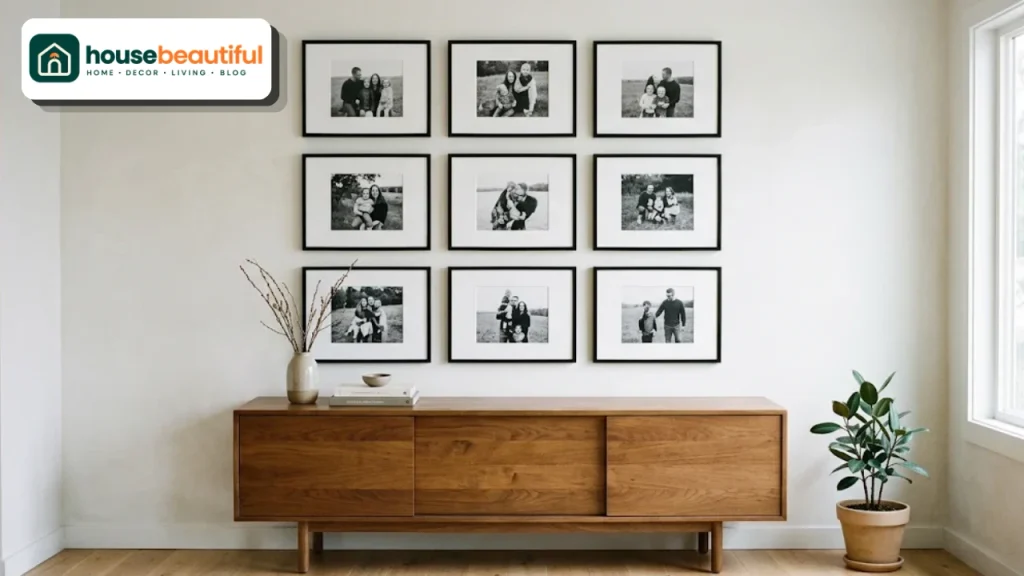
    Black-and-white family photo grid gallery in a sitting room

    Shelving and art combination

    Mix floating shelves with frames, adding books, plants,s and small objects between them.

    Personal mementos

    Frame meaningful items such as wedding invitations, handwritten letters, a grandparent’s recipe card or a child’s first shoes in a shadow box.

    Matching the Gallery to Your Decor Style

    A gallery looks best when it reflects the style of the room around it.

    Modern and minimal. Thin black or white frames, a strict grid, and monochrome or abstract art.

    Traditional. Gold or dark wood frames, oil paintings, landscapes and a symmetrical or salon layout.

    Scandinavian. Light oak frames, botanical and line-drawing prints, lots of white space and a neat grid.

    Bohemian. Mixed frames, woven hangings, plates, baskets and colorful prints in a loose cluster.

    Eastern or South Asian. Calligraphy, miniature paintings, embroidered textiles, brass and carved wooden frames.

    Farmhouse and rustic. Reclaimed wood frames, vintage signs, botanical prints and family photos.

    Gallery Ideas for a Formal Sitting Room
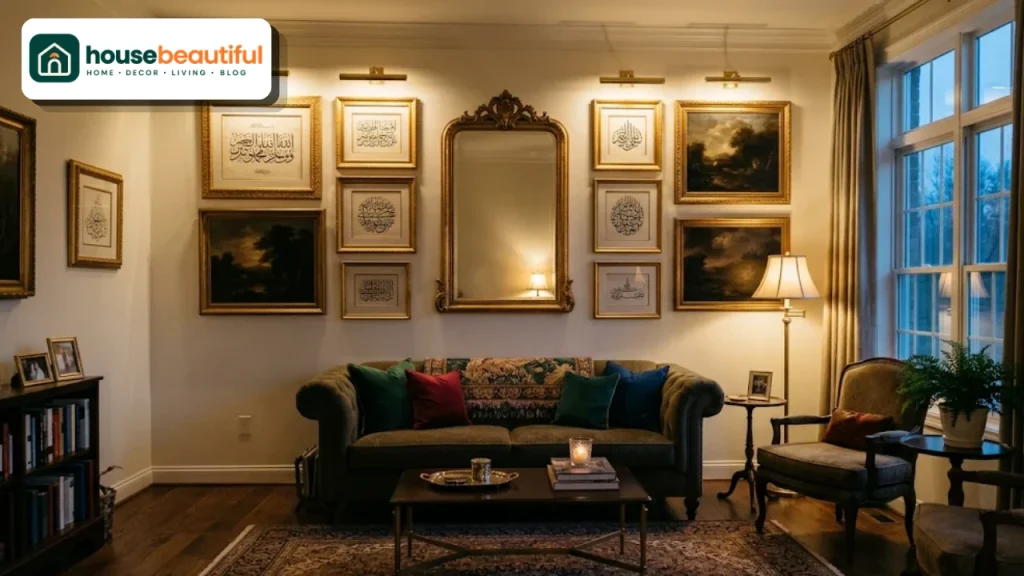
    Formal sitting room gallery with gold frames, calligraphy and picture lights

    In many homes, the sitting room or drawing room is a more formal space for guests. Here, the gallery should feel polished.

    Choose matching gold, black or dark wood frames. Calligraphy, landscape paintings, architectural prints and framed textiles all suit a formal room.

    A symmetrical layout above a sofa or on either side of a mirror creates a calm, elegant look. For more ideas on styling this kind of room, see our drawing room interior design ideas.

    Lighting Your Gallery

    Good lighting makes a gallery come alive in the evening.

    Picture lights. Brass or black picture lights above key pieces add a classic, museum-like glow.

    Track or spotlights. Adjustable ceiling spots can wash the whole gallery with light.

    Wall washers and LED strips. These create a soft, even light across the wall.

    Table and floor lamps. Lamps placed nearby gently light the display and add warmth to the room.

    Use warm white bulbs and avoid glare on glass by angling lights carefully. Anti-reflective glass helps in bright rooms.

    Galleries in Small Sitting Rooms

    A gallery can make a small room feel bigger and more personal if you plan it carefully.

    Choose a single wall and keep the gallery compact. A neat grid or linear arrangement looks tidier than a large salon wall.

    Use lighter frames and mounts to keep the look airy, and include a mirror or two to reflect light.

    Vertical arrangements draw the eye up and make low ceilings feel higher. For more space-saving tips, see our list of small living room ideas.

    Renter-Friendly Gallery Options

    You can create a gallery even if you can’t make holes in the walls.

    Adhesive picture-hanging strips hold lightweight frames securely and remove cleanly. Check the weight limits.

    Picture ledges need only a few screws, and you can rearrange frames as often as you like.

    Lean large frames on a sideboard or mantel, layering smaller frames in front.

    A picture rail with hanging wires is a traditional option that lets you move frames freely.

    Building a Gallery on a Budget

    A beautiful sitting room gallery doesn’t need expensive art.

    Print your own photos and free public-domain artwork from museum archives. Many museums offer high-resolution images free to download.

    Buy secondhand frames from markets and charity shops, then paint them in one color for a cohesive look.

    Frame fabric scraps, wallpaper samples, greeting cards, pages from old book,s or pressed leaves.

    Start small and add pieces over time. A gallery that grows naturally often looks more personal than one bought all at once.

    Planning the Gallery With Your Furniture

    A gallery should relate to the furniture below it. A gallery that’s wider than the sofa can feel top-heavy, while one that’s too small looks lost.

    Plan the furniture first, then the gallery. If you’re rearranging the room, our living room furniture layout plan guide helps you decide where the sofa and focal point should go.

    Once the furniture is in place, the gallery can frame it perfectly. For wider ideas on wall decor beyond galleries, read our guide on how to decorate a living room wall.

    Protecting Your Art and Photos

    Prints and photos last much longer with a little care.

    Hang galleries away from strong direct sunlight, or use UV-protective glass or acrylic for valuable pieces. Sunlight fades colors surprisingly quickly.

    Avoid humid spots near kitchens or bathrooms, which can cause warping and mold behind frames.

    Use acid-free mounts and backing for original artwork and old family photos. Scan precious photos first and hang a print, keeping the original safe.

    In homes with young children, choose acrylic instead of glass and secure frames with two hooks or safety hangers.

    Keeping Your Gallery Fresh

    A sitting room gallery doesn’t have to stay the same forever.

    Swap a few prints seasonally, or for Eid, weddings and holidays. A picture ledge makes this easy.

    Add new photos after important family events, and retire older ones to an album.

    Dust frames and glass regularly, and check that frames stay level, especially in busy rooms.

    Common Mistakes to Avoid

    Hanging too high. The most common mistake. Keep the gallery’s center near eye level and close to the furniture below.

    Uneven spacing. Random gaps make even good art look messy. Measure and keep gaps consistent.

    Too many tiny pieces. A wall full of small frames looks cluttered. Include a few larger pieces.

    No plan. Hammering nails without a layout leads to extra holes and a lopsided display. Use templates.

    Ignoring the room’s colors. A gallery that clashes with the room feels out of place. Repeat colors from the furnishings.

    Forgetting the furniture. The gallery should relate to the width of the sofa or console below.

    Bringing It All Together

    The best sitting room gallery starts with a clear plan: one wall, one layout, consistent spacing and art that means something to you.

    Measure carefully, test the arrangement with templates, and let the display grow over time. The result is a wall that feels personal, welcoming,ng and uniquely yours.
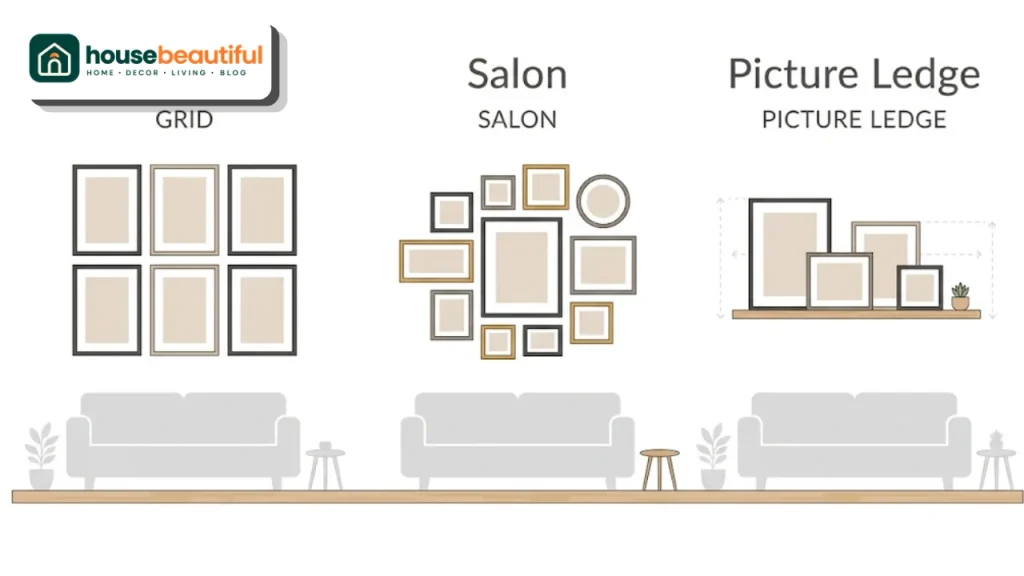
    Grid, salon and picture ledge gallery wall layouts compared

    FAQs:

    How high should a sitting room gallery wall be hung?

    Hang the center of the gallery about 145 cm (57 in) from the floor, and leave 15–25 cm between the bottom frame and the sofa or furniture below.

    How much space should be between frames in a gallery wall?

    Keep 5–8 cm (2–3 in) between frames, and keep the spacing consistent throughout.

    How wide should a gallery wall be above a sofa?

    About two-thirds of the sofa’s width usually looks balanced.

    Should all frames in a gallery wall match?

    Not necessarily. Matching frames look calm and modern, while mixed frames look eclectic. If you mix, keep one element consistent, like mount color.

    How do I plan a gallery wall layout?

    Lay the pieces out on the floor, trace them onto paper templates, tape the templates to the wall and adjust before hammering any nails.

    What should I put on a sitting room gallery wall?

    Family photos, prints, calligraphy, travel memories, mirrors, plates, texti,les and personal mementos all work well.

    Can I make a gallery wall without nails?

    Yes. Use adhesive hanging strips, picture ledges, a picture rail, or lean frames on furniture.

    Which wall is best for a gallery?

    The wall above the sofa or the wall facing the entrance is usually the best choice.

    How many pictures do I need for a gallery wall?

    There’s no fixed number. Small galleries can start with five to seven pieces; large walls may hold fifteen or more.

    How do I make a gallery wall look cohesive?

    Use a shared color palette, consistent spacing, a few repeated frame color,s and a clear anchor piece.
  • Classic Contemporary Living Room: How to Blend Timeless and New

    Classic Contemporary Living Room: How to Blend Timeless and New

    Some living rooms feel instantly right. There is a marble fireplace and elegant molding, but also a clean-lined sofa, a bold abstract painting, and a sculptural lamp. Nothing looks old-fashioned, and nothing looks like it will date next year.

    That balance is the heart of a classic contemporary living room. It borrows the proportion, symmetry, and craftsmanship of traditional design, then pairs them with the simplicity, comfort, and fresh materials of today.

    It is one of the most livable styles there is, but it is also easy to get wrong. Too much classic and the room feels stuffy;

    Too much contemporary and it loses its warmth. This guide explains how to strike the balance, with practical rules, furniture and color advice, and ideas for every size and budget.

    What Is Classic Contemporary Style?

    Classic contemporary style combines two design traditions in one room.

    The classic side brings architectural detail, symmetry, rich materials and timeless shapes: paneled walls, crown molding, fireplaces, rolled arms, turned legs, marble and brass.

    The contemporary side brings clean lines, a calm palette, less clutter, modern art, sculptural lighting and newer materials such as glass, lacquer and matte metals.

    The result feels elegant but relaxed. It suits period homes that want a fresh update, as well as new homes that need character.

    Why This Style Works So Well

    Classic contemporary design has lasted because it solves a real problem. Purely traditional rooms can feel formal and heavy, while purely modern rooms can feel cold and impersonal.

    Combining the two gives you the comfort and character of classic design without the clutter, and the freshness of contemporary design without the sterility.

    It is also forgiving. Because the style deliberately mixes old and new, you can add a vintage find or a modern piece over time, and it will still fit.

    That makes it ideal for people who inherit furniture, love antiques,s or simply want a room that evolves.

    Finally, it ages well. Classic proportions and quality materials never really go out of style, and the contemporary elements are usually easy to update, such as art, cushions or a lamp.

    Classic vs. Contemporary vs. Transitional

    These terms are often used together, so it helps to see how they differ.

    FeatureClassicContemporaryClassic contemporary
    LinesCurved, ornateClean, simpleTailored classic shapes with simplified details
    PaletteRich, layered colorsNeutral with bold accentsWarm neutrals with one or two deep accents
    MaterialsDark wood, damask, giltGlass, metal, concreteMarble, brass, wood, linen, velvet
    AccessoriesMany antiques and collectionsMinimal, sculpturalA few classic pieces, modern art
    MoodFormalRelaxed, airyElegant but comfortable

    Transitional style is a close cousin. It usually leans more neutral and softer, while classic contemporary often keeps stronger architectural detail and more contrast.

    The Golden Rules of Blending Classic and Contemporary

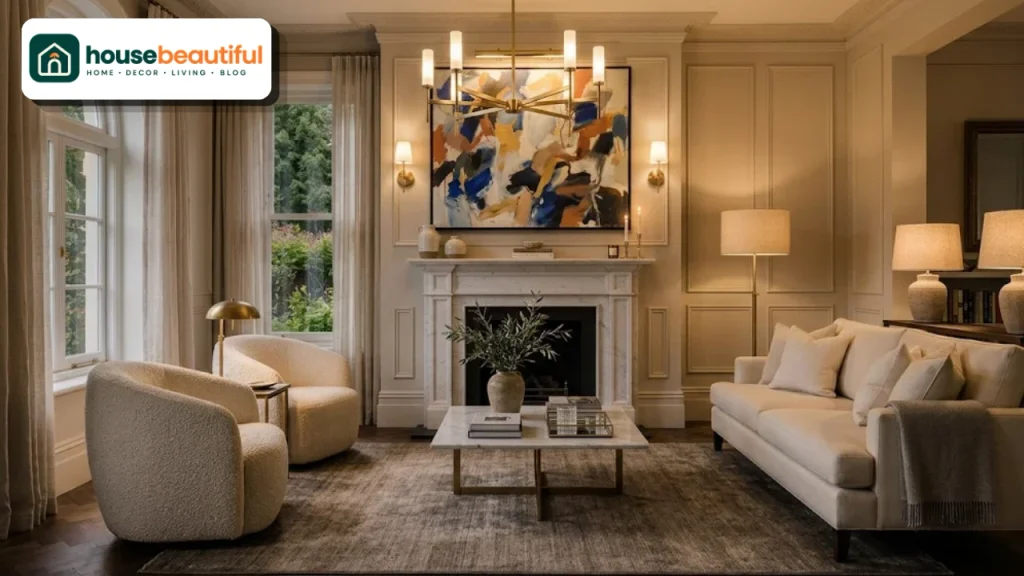
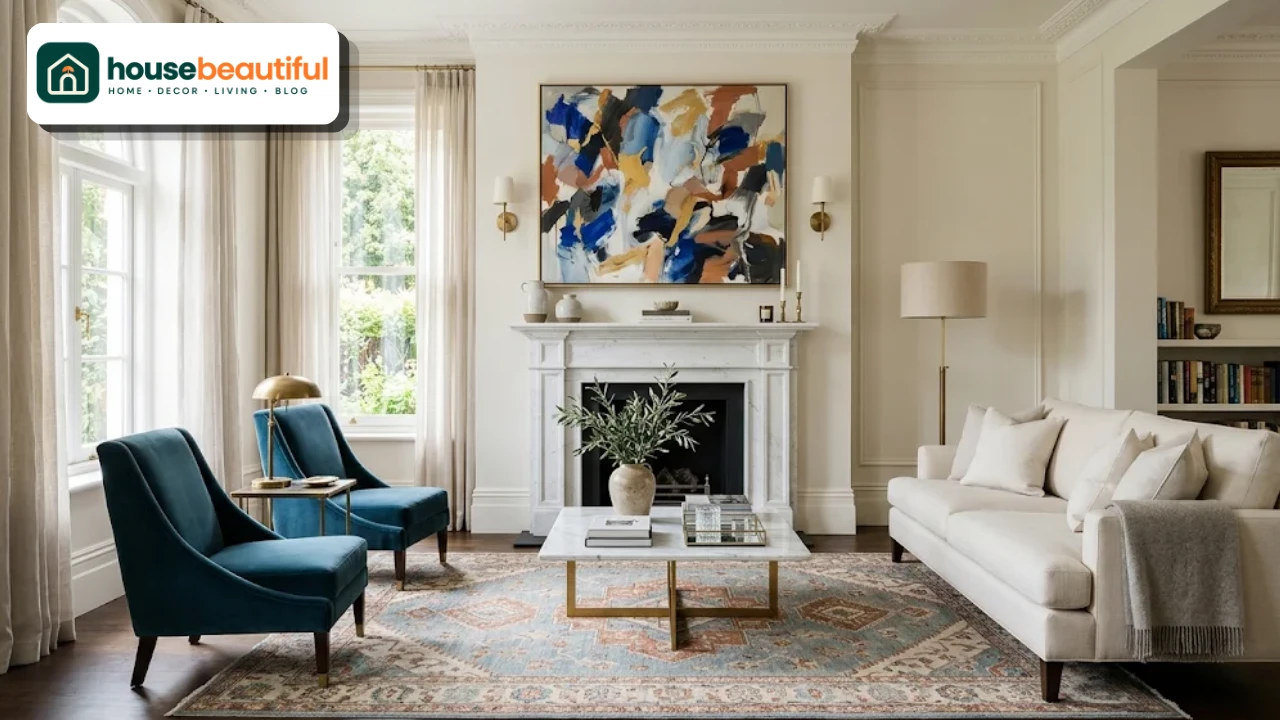
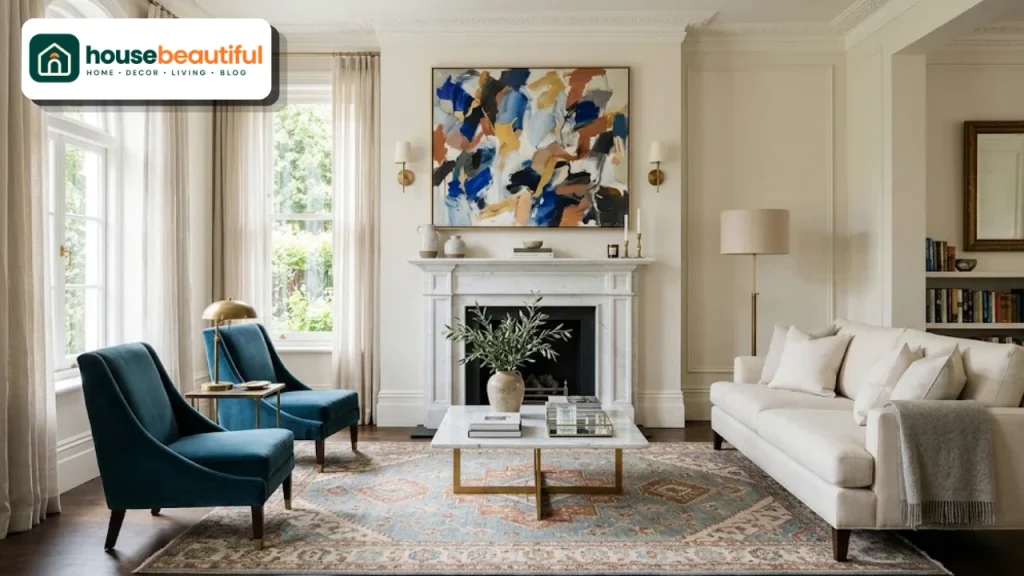
    Classic contemporary living room with marble fireplace, abstract art and tailored sofa

    The secret of a successful classic contemporary living room is intentional mixing. These rules keep the blend calm and cohesive.

    Choose a lead style

    Decide which style leads, then let the other support it. A common ratio is around 70 percent one style and 30 percent the other.

    In a period home, classic architecture often leads and contemporary furniture supports. In a new build, contemporary architecture leads and classic pieces add soul.

    Repeat a unifying palette

    Use a restrained palette across both classic and contemporary pieces. When an antique chair and a modern sofa share a color or tone, they look like they belong together.

    Use bridge pieces

    Some pieces naturally sit between the two styles: a tailored sofa with a slim rolled arm, a marble coffee table with a simple base, or a brass lamp with a clean drum shade. These bridge pieces connect the old and the new.

    Balance shapes

    Pair curves with straight lines. A curvy classic armchair looks fresh beside a sharp-edged contemporary coffee table, and a sleek sofa softens under an ornate gilt mirror.

    Keep it edited

    Classic rooms traditionally display many objects. In a classic contemporary room, choose fewer, better pieces and leave space around them. Negative space is what keeps the look modern.

    Start With the Architecture

    Architecture gives a classic contemporary room its backbone.

    If your room already has molding, a ceiling rose or a fireplace, celebrate it. Paint the trim the same color as the walls for a modern, tonal look, or pick it out in a slightly deeper shade for definition.

    If your room is a plain box, add classic detail. Picture-frame molding, wall paneling, a simple cornice or a new mantelpiece can transform a builder-grade space. Keep profiles simple and clean so they feel contemporary rather than fussy.

    Tall, generous doorways and windows also feel classic. Floor-length curtains hung close to the ceiling exaggerate height and add elegance.

    Wall Treatments

    Walls are where classic detail and contemporary restraint meet.

    Picture-frame molding painted in the same color as the wall gives classic structure with a quiet, modern finish. Full-height paneling behind the sofa or around the fireplace adds richness.

    Wallpaper can work too. Choose subtle textures such as grasscloth or linen-look papers, or a large-scale classic pattern in a muted colorway for a feature wall.

    Limewash or textured plaster finishes add depth and suit both styles, softening large walls without adding pattern.

    Ceiling Details

    Ceilings are often forgotten, yet they offer an easy way to add classic character.

    A simple cornice or crown molding frames the room. A ceiling rose around a chandelier is a lovely classic touch that looks fresh when painted the same color as the ceiling.

    In rooms with higher ceilings, a coffered or tray ceiling adds drama. Keep the profiles crisp and clean so they read as contemporary rather than ornate.

    Color Palettes for a Classic Contemporary Living Room

    Color is one of the strongest tools for uniting old and new.

    Warm neutrals

    Ivory, warm white, greige, stone and soft taupe are the classic foundation. They let architecture and furniture shine and make mixing styles easy.

    Deep accents

    Navy, forest green, oxblood, charcoal and chocolate add depth and sophistication. Use them on a sofa, a pair of chairs, a lacquered cabinet or one feature wall.

    Tonal schemes

    A tonal scheme uses several shades of one color, such as cream through camel to cognac. It feels calm and expensive and keeps a mixed room cohesive.

    Black accents

    A touch of black, on picture frames, lamp bases, a coffee tabl,e or window frames, sharpens a classic room and makes it feel more contemporary.

    Our guide to living room paint colors has more help choosing the right shade for your light.

    Furniture Ideas

    The furniture is where classic and contemporary meet most directly.

    The sofa

    A tailored sofa with clean lines and a hint of classic detail, such as a slim rolled arm, tight ba,ck or turned legs, is ideal. Tufted sofas in neutral linen or velvet also bridge both styles.

    Accent chairs

    Pair a modern sofa with classic chairs, such as wingbacks, bergeres or slipper chairs. Or do the reverse: a classic sofa with sculptural, curved contemporary chairs.

    Coffee table

    Marble, travertine or stone coffee tables suit this style beautifully. Round or oval shapes soften a room, while a rectangular marble table feels more formal.

    Storage and case goods

    A lacquered or painted cabinet, a classic chest with modern hardware, or built-in bookshelves around the fireplace all work well.

    PieceClassic optionContemporary optionBridge choice
    SofaChesterfieldLow modularTailored sofa with slim rolled arm
    ChairsWingbackCurved boucleSlipper chair in velvet
    Coffee tableCarved woodGlass and metalMarble with simple base
    LightingCrystal chandelierSculptural pendantBrass chandelier with clean lines
    MirrorGilt overmantelFramelessSlim brass or antique-finish frame

    Layout and Symmetry

    Classic rooms rely on symmetry, which brings calm and order. Contemporary rooms often use asymmetry for interest. A classic contemporary room uses both.

    Arrange the main seating symmetrically around the fireplace or focal wall: two sofas facing each other, or a sofa with matching chairs opposite. Then introduce asymmetry through accessories, art and a single statement chair.

    Keep walkways of around 30 to 36 inches and place the coffee table about 16 to 18 inches from the sofa. Choose a rug large enough for the front legs of all the seating to rest on it.

    For more on arranging seating, see our post on living room layout ideas.

    The Fireplace and Focal Wall

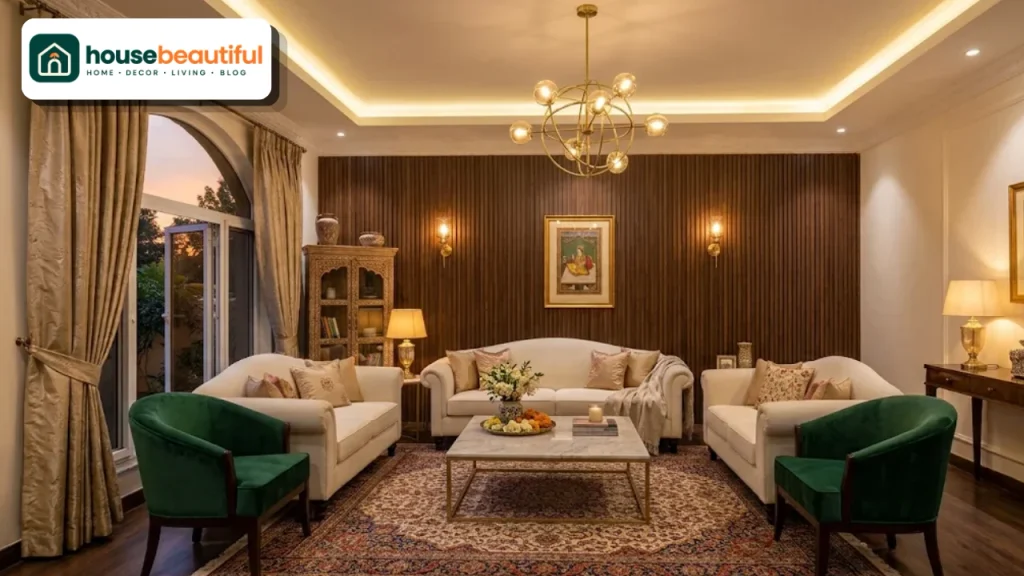
    Classic contemporary living room with brass chandelier and table lamps

    In most classic contemporary rooms, the fireplace is the star. It brings symmetry, warmth and a natural focal point.

    A classic marble or stone mantel looks fresh with a large abstract painting or a frameless mirror above it. A pair of matching lamps or vases on the mantel adds symmetry, while one off-center sculptural object adds a contemporary twist.

    If there is no fireplace, create a focal wall. Built-in bookcases with paneled backs, a large piece of art above a console, or a feature wall in a deep color all work well.

    Many homeowners place the TV on this wall too. Framing it with shelving or paneling, or choosing a frame-style TV that displays art,

    keeps the focal point elegant. In a classic contemporary living room, the TV should never be the only thing the eye lands on.

    Flooring Choices

    Flooring sets the tone for the whole room.

    Herringbone or chevron wood floors are a classic detail that suits contemporary furniture perfectly. Wide-plank oak in a mid-tone feels warm and modern.

    Marble or large-format stone-look tiles bring a luxurious, gallery-like feel, especially in warmer climates. Soften them with a large wool or silk-blend rug to keep the room cozy and quiet.

    Lighting

    Lighting is a perfect place to mix styles.

    A classic chandelier, whether crystal or brass, becomes contemporary when paired with clean-lined furniture and a calm palette. Alternatively, a sculptural modern pendant looks striking against classic molding.

    Use pairs of table lamps on side tables or a console for classic symmetry. Add picture lights above art, wall sconces beside the fireplace and a slim floor lamp beside a reading chair.

    Warm bulbs around 2700K and dimmers keep the room elegant and inviting in the evening. For more ideas, see our guide to living room lighting.

    Rugs, Curtains and Textiles

    Textiles soften a classic contemporary room and tie its pieces together.

    A Persian or Oushak-style rug brings classic warmth and pattern, and it looks especially fresh in a contemporary setting. A flat-weave or subtle modern rug works well under classic furniture.

    Curtains in linen, wool or velvet, hung high and long, add elegance. Keep the hardware simple, such as slim brass or black rods.

    Mix textures: velvet, linen, boucle, wool and leather. Keep cushion colors within your palette and vary patterns, such as a classic stripe with a modern geometric.

    Storage and Display

    Classic rooms often celebrate collections, but contemporary design asks for restraint. The answer is to display less and store more.

    Built-in bookcases on either side of a fireplace are a classic feature that also provides practical storage.

    Use closed cabinets below for everyday items and open shelves above for books and a few treasured objects.

    When styling shelves, group items by color or material, leave generous gaps and mix horizontal and vertical stacks of books. One or two classic pieces, such as a pair of porcelain vases, look striking next to modern ceramics.

    A sideboard or console behind the sofa offers another surface for lamps and display, while hiding chargers, remotes and games inside.

    Art and Accessories

    Art is one of the easiest ways to make a classic room contemporary.

    A large abstract painting above a traditional fireplace is a signature classic contemporary move. Black-and-white photography in simple frames, or a modern sculpture on a classic console, creates the same contrast.

    Keep accessories edited. Choose a few meaningful objects: a pair of classic vases, a stack of art books, a sculptural bowl and fresh flowers or branches.

    For hanging heights and sizing, read our guide on how to decorate a living room wall.

    Mirrors add light and elegance. A large gilt or antique-finish mirror over the mantel looks classic, while a round mirror with a slim frame feels more contemporary.

    Bringing in Greenery

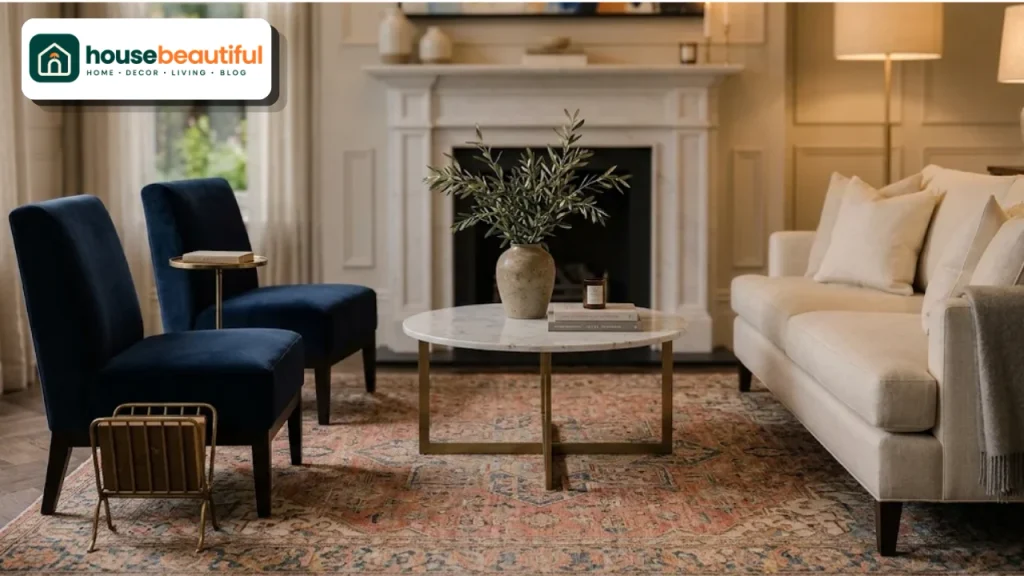
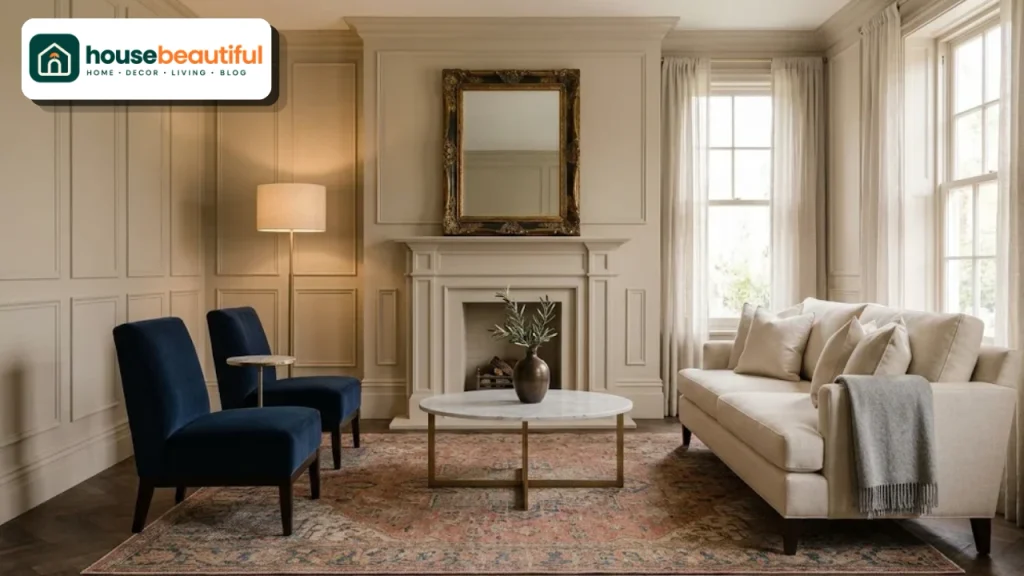
    Tailored sofa, velvet slipper chairs and marble coffee table in a classic contemporary living room

    Plants soften classic architecture and make a room feel lived-in.

    A tall olive tree or fiddle-leaf fig in a classic urn or a simple stone pot suits this style. Smaller arrangements of branches, orchids or fresh flowers on the coffee table or mantel add life without clutter.

    Keep containers in a consistent palette, such as stone, terracotta or matte black, so plants feel part of the design.

    Materials and Finishes

    Materials carry a lot of the style.

    Marble, travertine and limestone feel classic and luxurious, yet suit modern shapes. Brass and bronze add warmth; mixing them with matte black keeps the look current.

    Wood should be warm and natural. Mid-tone and dark woods feel classic, while lighter oak feels contemporary. Using both, in a consistent family of tones, works well.

    Choose a small set of finishes and repeat them across the room. Repetition is what makes a mix of styles feel deliberate.

    Updating an Existing Traditional Room

    Many people arrive at this style by updating a traditional living room rather than starting from scratch. The good news is that you can usually keep most of what you have.

    Start by editing. Remove about a third of the accessories and any furniture that crowds the room. Space alone will make the room feel more contemporary.

    Repaint in a calmer, warmer neutral, and consider painting dark wood trim to match the walls. Replace heavy, patterned curtains with simpler linen or wool panels.

    Then introduce two or three contemporary pieces: a large abstract artwork, a sculptural lamp or pendant, and a clean-lined coffee table or accent chair. These few changes shift the whole balance of the room.

    Open-Plan Classic Contemporary Spaces

    The style also works in open-plan homes, where the living room flows into dining and kitchen areas.

    Define the living zone with a large classic-style rug and the back of a tailored sofa. Use a statement chandelier over the dining table and a different but related light over the seating area.

    Repeat finishes across the whole space, such as brass in the kitchen hardware, dining chandelier and living room lamps. This repetition makes an open plan feel like one considered classic contemporary living room rather than separate areas.

    Seasonal Styling

    A calm classic contemporary base makes seasonal changes easy.

    In spring and summer, use linen cushions, lighter throws, fresh flowers and branches, and keep surfaces clear. Let natural light dominate.

    In autumn and winter, layer velvet cushions, wool throws and candles on the mantel. Swap in deeper-toned flowers or dried arrangements for a richer, cozier mood.

    Keep seasonal changes to textiles and accessories, so the core design stays timeless.

    Small Classic Contemporary Living Rooms

    A classic contemporary living room works beautifully in smaller spaces with a few adjustments.

    Use a light, tonal palette and paint walls and trim the same color to make the room feel bigger. Choose a compact tailored sofa and one or two slim chairs rather than a full suite.

    A round marble side table or a small oval coffee table saves space. A large mirror opposite a window doubles the light.

    Keep accessories to a minimum and use wall-mounted lights to free surfaces. Our post on small living room ideas has more space-saving tips.

    Family-Friendly Classic Contemporary Rooms

    Elegance and family life can go together.

    Choose performance velvet or washable linen slipcovers for the sofa. Mid-tone colors hide marks better than pure white.

    Rounded coffee tables, such as a stone oval or upholstered ottoman, are safer for children. Closed storage keeps toys out of sight, so the room can return to calm quickly.

    A practical classic contemporary living room might have a tufted ottoman instead of a glass coffee table, washable rugs and a cabinet that hides games and remotes.

    Budget-Friendly Ideas

    You can achieve this look without a large budget.

    Low-cost changeImpact
    Add simple picture-frame moldingInstant classic architecture
    Paint walls and trim one warm neutralCalm, modern backdrop
    Hang curtains high and longElegant, taller room
    Swap lampshades and hardware to brass or blackUpdated finishes
    Buy one vintage pieceAdds soul and history
    Hang one large abstract printContemporary focal point

    Vintage and secondhand shops are full of classic pieces, such as mirrors, chairs and side tables, that become contemporary when paired with clean-lined furniture.

    A Step-by-Step Plan

    Follow this order to build the room with confidence.

    Decide whether classic or contemporary will lead.

    Choose a palette of two or three main colors plus black accents.

    Add or restore architectural details such as molding or a mantel.

    Plan the layout around the focal point with symmetrical seating.

    Buy the sofa and rug, then bridge pieces such as a marble coffee table.

    Layer lighting: chandelier or pendant, table lamps and sconces.

    Add art, mirrors, textiles and a few meaningful accessories.

    Common Mistakes to Avoid

    Too much of everything. Filling the room with antiques and accessories makes it feel dated. Edit ruthlessly.

    No unifying palette. Mixed styles need a shared color story to feel cohesive.

    Matching furniture sets. A matching suite looks like a showroom. Mix pieces with care.

    Ignoring scale. Classic pieces can be large. Make sure furniture fits the room and leaves space to move.

    Cold contemporary pieces only. Without warm wood, texture ,and soft lighting, the room can feel sterile.

    Small classic contemporary living room with tonal walls and a large gold mirror

    FAQs:

    What is a classic contemporary living room?

    It is a living room that blends traditional elements, such as molding, symmetry,y and classic furniture shapes, with contemporary clean lines, calm colors, and modern art.

    How do I mix classic and contemporary furniture?

    Choose a lead style, keep a consistent color palette, use bridge pieces that combine both styles, and balance curved and straight lines.

    What colors suit a classic contemporary living room?

    Warm neutrals such as ivory, greig,e and stone, withbroadp accents like navy, forest green or oxblood, and touches of black.

    Is classic contemporary the same as transitional?

    They are similar. Transitional usually leans softer and more neutral, while classic contemporary often keeps stronger architectural detail and contrast.

    What furniture suits this style?

    Tailored sofas, wingback or slipper chairs, marble coffee tables, brass lighting, and classic cabinets with modern hardware.

    How do I make a traditional living room feel more contemporary?

    Simplify the palette, remove clutter, add abstract art, use sculptural llightingg and introduce some clean-lined furniture.

    What rug works in a classic contemporary living room?

    A Persian or Oushak-style rug adds classic warmth, while a subtle modern rug suits more traditional furniture.

    Can a small room be classic contemporary?

    Yes. Use a light tonal palette, compact tailored furniture, a large mirr,or and minimal accessories.

    What lighting suits this style?

    A classic or sculptural chandelier, pairs of table lamps, wall sconces and picture lights, all with warm bulbs.

    Does classic contemporary style date quickly?

    No. Because it balances timeless architecture with restrained modern elements, it ages more gracefully than trend-led styles.

  • Large Contemporary Living Room: Design Ideas That Fill the Space

    Large Contemporary Living Room: Design Ideas That Fill the Space

    A big living room sounds like a dream. Then the furniture arrives, and somehow the room still looks half-empty.

    The sofa floats in the middle of the floor. Voices echo off the walls. The beautiful high ceiling makes everything below it look small, and the room feels more like a hotel lobby than a place to curl up with a book.

    This is the most common problem with a large contemporary living room, and it has nothing to do with taste. It is about scale, zoning, light and texture.

    This guide explains how designers handle each one, so your big room feels generous, calm and genuinely lived-in.

    What Does Contemporary Mean in a Living Room?

    Contemporary design simply means the style of the present moment. It changes over time, which is why it is often confused with modern design.

    Modern design refers to a specific historic movement from the early and mid-twentieth century, with its clean lines and functional furniture.

    Contemporary design borrows from it but stays current, absorbing new materials, colors, and shapes.

    Today, contemporary living rooms tend to share a few traits: clean architecture, a calm and often warm neutral palette, a mix of natural materials, curved or sculptural furniture, generous natural light, and very little clutter.

    In a large room,m these traits are an advantage. Clean lines and a restrained palette stop a big space from feeling chaotic. The challenge is keeping it warm.

    The Big-Room Challenge

    Large living rooms fail in predictable ways. Understanding them makes the solutions obvious.

    Furniture that is too small. Standard sofas and rugs look lost in a big room, leaving islands of furniture in a sea of floor.

    Everything against the walls. Pushing furniture to the edges leaves a huge empty middle and makes conversation difficult.

    One overhead light. A single fixture cannot light a large volume well, so the room feels dim in the corners and flat everywhere else.

    Hard surfaces everywhere. Large windows, stone or tile floors,s and bare walls bounce sound around, creating echo.

    No sense of purpose. A big room with one sofa and a TV wastes its potential. Large rooms work best when they do more than one thing.

    Every idea that follows addresses one or more of these problems.

    Zoning: The Secret to a Large Living Room

    The single most important idea for any large contemporary living room is zoning. Instead of treating the room as one space, divide it into two or three smaller areas, each with its own purpose.

    Choose your zones

    Most large living rooms have room for a main conversation or TV zone plus one or two secondary areas. Popular secondary zones include a reading corner, a small game or tea table, a home office nook, a bar area, a piano or a play space.

    Think about how your household spends its evenings and weekends. The zones should match real habits, not a magazine photo.

    Anchor each zone with a rug

    A rug is the easiest way to define a zone. Give the main seating area a large rug, then use a smaller rug for a reading corner or dining area.

    The rugs do not need to match, but they should relate in color or texture so the room still feels unified.

    Use furniture as walls

    The back of a sofa makes an excellent low divider. A slim console table behind it adds a surface for lamps and books while signaling the edge of the seating zone.

    Open shelving units, a pair of tall plants or a low bench can also separate areas without blocking light.

    Use light to define space

    A pendant hung over a tea table, a floor lamp marking a reading chair, or a cluster of lights over a bar area all help each zone feel like a distinct place.

    Layout Ideas for a Large Contemporary Living Room

    Once you know your zones, choose a layout for the main seating area. These three work especially well in big rooms.

    The conversation square

    Place a large sofa facing two armchairs, with a second sofa or a bench closing the square. A big coffee table in the middle completes the arrangement.

    This layout feels sociable and intentional, and it works even without a TV.

    The oversized sectional

    A large L-shaped or U-shaped sectional with a pair of armchairs opposite creates a generous lounging area. Float it in the room rather than pushing it into a corner.

    Modular sectionals are ideal because they can be reconfigured as needs change.

    Facing sofas around a fireplace

    Two identical sofas facing each other, perpendicular to a fireplace or focal wall, create symmetry and calm. Add a pair of chairs at the open end for extra seating.

    Keep comfortable distances

    Even in a large room, seating should stay close enough for conversation. The room may be big, but the conversation group should feel intimate.

    Furniture Ideas for a Large Contemporary Living Room

    The right furniture does most of the work in a large contemporary living room. Look for pieces with presence, clean lin,es and a mix of shapes.

    Curved and sculptural seating

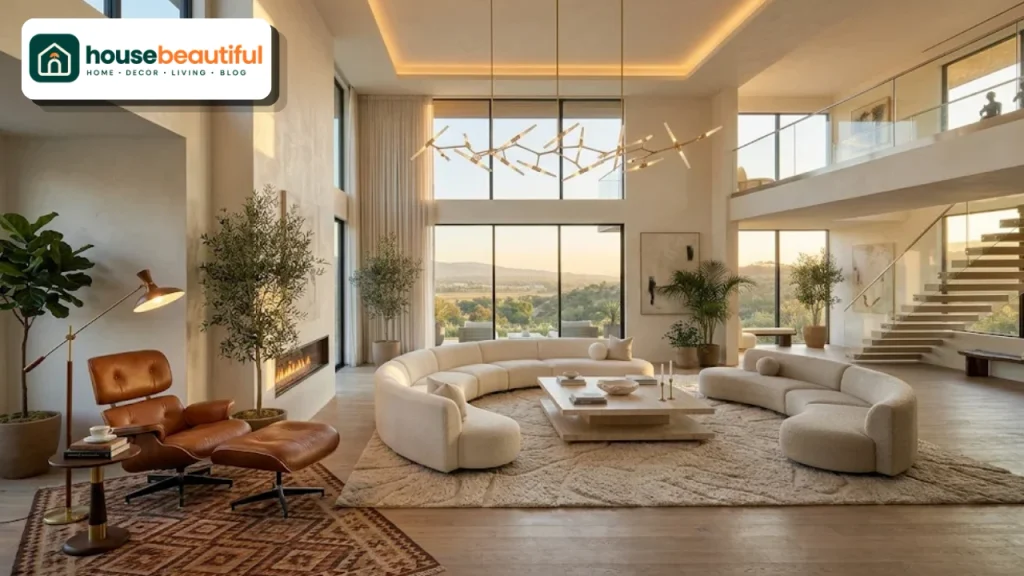
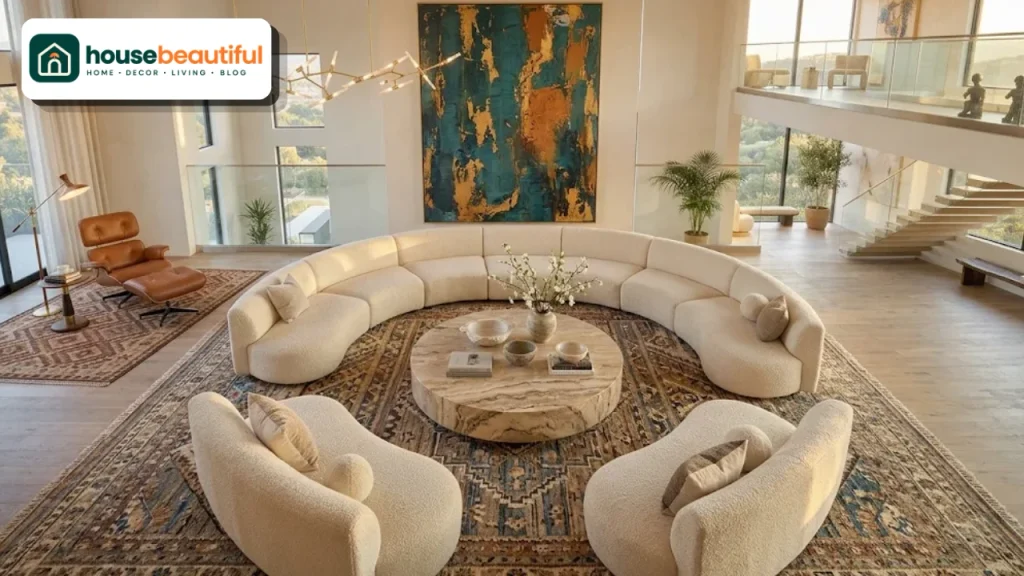
    Curved sofas and rounded accent chairs are a defining contemporary look. In a big room, a curved sofa softens hard architecture and naturally creates a sociable, enclosed seating area.

    Low, deep sofas

    Low-slung, deep-seated sofas feel relaxed and modern. They also keep sightlines open across a large room, so the space still feels airy.

    Statement accent chairs

    A pair of sculptural chairs in leather, bouclé,cle or velvet adds personality. In a large room, chairs can be slightly bigger and bolder than usual.

    Substantial tables

    Choose a large coffee table in stone, wood or travertine, or group two smaller tables together. Add side tables beside every seat so guests always have somewhere to put a drink.

    Benches and ottomans

    A long upholstered bench or a pair of large ottomans provide flexible extra seating and can close off a conversation square without blocking views.

    Getting the Scale Right

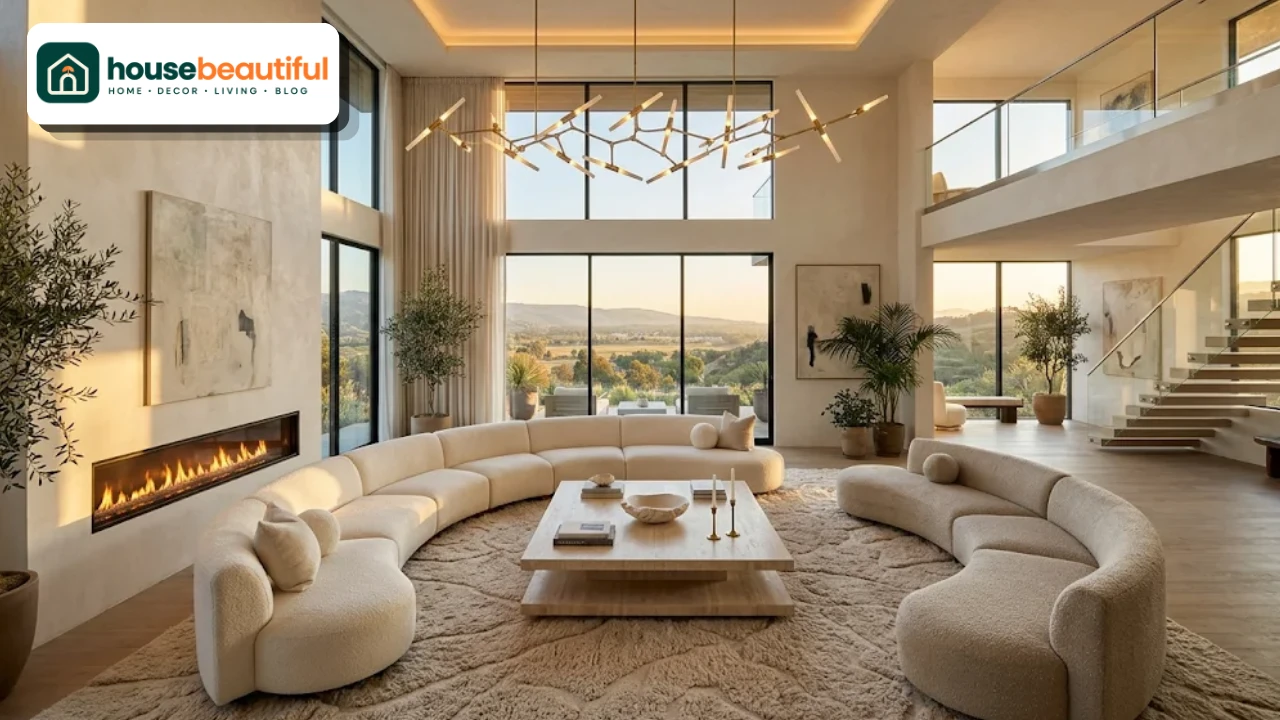
    Large contemporary living room zoned into a seating area and a reading corner

    Scale is where most large rooms go wrong. Oversize your key pieces and the room immediately looks more finished.

    ElementGuideline for a large roomWhy it matters
    Main rugLarge enough for all seating legs to sit on it; often 10 x 14 ft or largerPulls the group together
    Sofa or sectionalGenerous length and depth; consider a sectionalMatches the room’s proportions
    Coffee tableAbout two-thirds the length of the sofaKeeps it reachable and in proportion
    Sofa to coffee tableAbout 16 to 18 inchesEasy to reach without crowding
    Seats facing each otherAbout 8 to 10 feet apartComfortable conversation distance
    Art above sofaAbout two-thirds the sofa widthAvoids the “postage stamp” effect

    Large rooms can also take larger single pieces: a big sculptural coffee table, oversized art, a tall arc ,lamp, or a substantial bookcase. A few big items look calmer than many small ones.

    Colors for a Large Contemporary Living Room

    Color can make a big room feel warmer and more connected.

    Warm neutrals

    Contemporary rooms often start with warm whites, greige, sand, mushroom,m and soft taupe. Warmer neutrals have largely replaced cool grays, and they make a large space feel inviting rather than stark.

    Deeper accent walls

    A large room can carry darker colors without feeling closed in. A deep olive, charcoal, ink blue, or chocolate brown on one wall, or on a media wall, adds depth and makes the space feel more intimate.

    A restrained palette

    Choose two or three main colors and repeat them across zones. Repetition is what makes a big room feel like one design rather than separate pieces.

    Color drenching

    For a cocooning effect, paint walls, trim,m and even the ceiling in the same color. It works beautifully in a large room with high ceilings, softening the volume.

    Materials and Textures

    Texture is what makes a contemporary room feel warm instead of cold.

    Mix natural materials: oak or walnut wood, stone or marble, plaster walls, linen and wool upholstery, boucle chairs, leather cushions and jute or wool rugs. Each adds a different surface for the eye.

    Contemporary rooms often use matte finishes, brushed brass, matte black metal and natural stone. Combining a few of these creates depth without clutter.

    Limewash or textured plaster walls are particularly effective in big rooms. They catch light across a large surface and make walls feel soft and rich rather than flat.

    Focal Points: Fireplace, TV and Art

    A large room needs a strong focal point, or the eye has nowhere to rest.

    Contemporary fireplaces

    A long, linear ribbon fireplace set into a plaster, stone or concrete wall is a signature contemporary feature. A two-sided fireplace can also act as a divider between zones.

    Keep the surround simple and let the material speak.

    Media walls

    If the TV is central to the room, design a media wall around it. Built-in shelving, slatted wood panels,ls or a dark painted wall can frame the screen so it blends into the design instead of dominating it.

    Many large contemporary rooms combine a fireplace and TV on the same wall. Keep the TV at a comfortable viewing height rather than high above the fireplace if possible.

    Oversized art

    A single large artwork or a pair of matching canvases makes a confident statement in a big room. Sculpture on a plinth or a large ceramic piece works too.

    Flooring Choices

    Flooring covers more area in a big room than any other surface, so it shapes the whole look.

    Wide-plank oak or engineered wood brings warmth and suits most contemporary styles. Large-format porcelain or stone-look tiles create a seamless, minimal surface and stay cool in warm climates.

    Polished concrete and microcement give an architectural, gallery-like feel, but they need large rugs to soften both the look and the acoustics.

    Whatever you choose, run it continuously through connected spaces. Fewer transitions make a large area feel calmer and more expansive.

    Storage and Built-Ins

    Clutter is very visible in a big, minimal room, so storage matters even more.

    Built-in cabinetry along one wall, with closed lower cupboards and open shelves above, gives a large contemporary living room a tailored, architectural look. Flat-front, handleless doors keep the lines clean.

    A long, low media unit can stretch across a whole wall, housing electronics, games and everyday items while providing a surface for art and objects.

    Hidden storage inside ottomans, benches and coffee tables keeps throws, remotes and chargers out of sight.

    Styling Shelves and Surfaces

    Oversized rug and sectional scaled to a large contemporary living room

    In a contemporary room, styling is about restraint. Each surface should look considered, not crowded.

    Group objects in odd numbers and vary their height and shape. Mix books laid flat and upright, ceramics, a small plant, and one or two personal pieces.

    Leave empty space on every shelf. In a large room, negative space looks intentional and calm.

    On the coffee table, a large tray, a stack of books, and a vase with branches or flowers are usually enough.

    Lighting a Large Living Room

    Lighting a large room well takes more sources than most people expect.

    Start with ambient lighting: recessed lights, cove lighting, or a large statement pendant. In very big rooms, use more than one ceiling fixture so the light is even.

    Add task lighting with floor and table lamps beside seats, especially in reading corners. Then layer in accent lights: picture lights over art, LED strips in shelving,g and wall sconces.

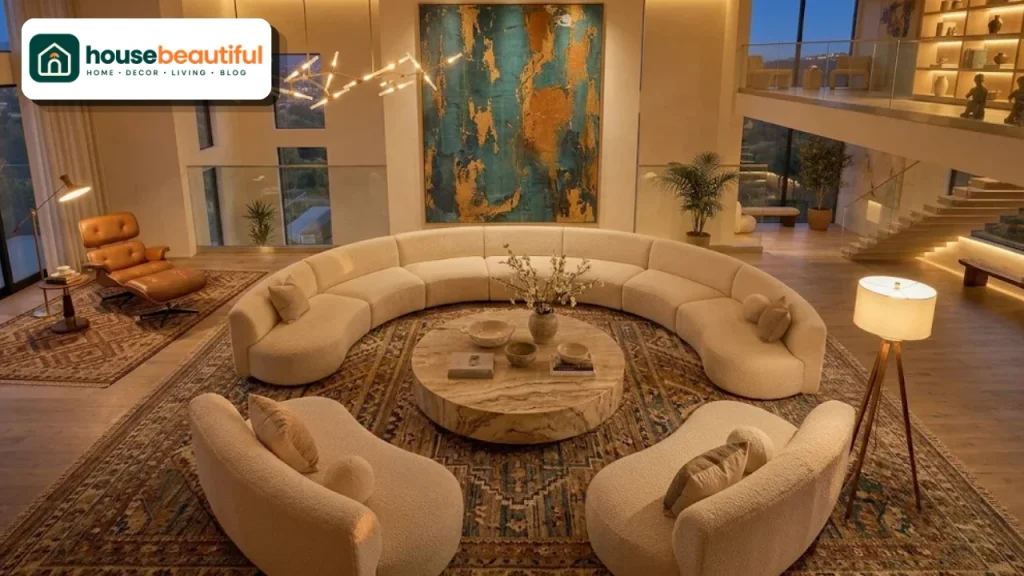
    A large sculptural pendant or a cluster of pendants over the seating area can define the main zone and act as art in its own right.

    Put each zone on separate switches and use dimmers. Warm bulbs around 2700K help a large space feel cozy in the evening.

    Ceilings and Windows

    High and vaulted ceilings

    Tall ceilings are beautiful but can make furniture look small. Bring the eye down with a large pendant, tall bookshelves, oversized art, or exposed beams.

    Painting the ceiling a warm shade, or adding wood paneling to it, makes a tall room feel more intimate.

    Floor-to-ceiling windows

    Large windows are a highlight of many contemporary rooms. Dress them with floor-length sheer curtains on a ceiling track to soften the glass without blocking light.

    Motorized blinds or curtains are practical for very large windows, and they help manage heat, glare and privacy.

    Connecting Indoors and Outdoors

    Many large contemporary living rooms open onto a terrace, garden or balcony through wide sliding or folding doors. Treating the two spaces as one makes the room feel even bigger.

    Use a similar color palette and materials inside and out, such as matching stone tones or the same wood. Position the main seating so it enjoys the view, rather than turning its back on the garden.

    Large pots with trees or tall grasses just outside the glass extend the green into the room. At night, soft outdoor lighting stops the windows from turning into black mirrors and keeps the view alive after dark.

    Making a Large Room Feel Cozy

    A big room does not have to feel cold. These ideas bring warmth and intimacy.

    Group seating closely, even if the room is large. Add plenty of soft furnishings: cushions, throws, upholstered chairs,s and a deep-pile or wool rug.

    Bring in plants, especially large ones such as fiddle-leaf figs, olive trees or bird of paradise. They fill vertical space and soften hard lines.

    Use warm lighting at multiple heights, and avoid bright overhead light in the evening.

    Managing Acoustics

    Echo is one of the biggest complaints in large contemporary rooms. Hard floors, windows,ws and minimal furniture all reflect sound.

    Large rugs, upholstered furniture, heavy curtains and full bookshelves absorb sound. Fabric wall panels or slatted wood panels with acoustic backing can be both decorative and functional.

    Even a few large cushions and a fabric-covered headboard-style panel behind the sofa make a noticeable difference.

    Living With Kids and Pets

    A large contemporary living room can look sleek and still handle family life. The key is choosing finishes that forgive.

    Performance fabrics, washable slipcovers and leather resist spills and claws better than delicate linen or silk. Mid-tone upholstery hides marks far better than pure white.

    Rounded coffee tables and curved furniture are safer for small children, and they suit the contemporary look perfectly. A flat-weave or low-pile wool rug is easier to clean than a shaggy one.

    Use the extra space to your advantage. A secondary zone with low shelves, a soft rug and storage baskets can become a play corner that is easy to tidy away when guests arrive.

    Seasonal Styling

    Contemporary rooms rely on a calm base, which makes seasonal updates easy.

    In warmer months, use light linen cushions, sheer curtains drawn back, fewer throws and plenty of greenery. Let the large windows do the work.

    In cooler months, layer wool and boucle throws, velvet cushions and a thicker rug in the seating zone. Add candles and more lamp light to make the large volume feel snug.

    Keep these changes to textiles and accessories. The main furniture and palette stay the same, so the room always feels cohesive.

    Open-Plan Large Living Rooms

    Many large contemporary living rooms are part of an open-plan space with the kitchen and dining area.

    Use the same flooring throughout to keep the space connected, and define the living area with a rug and the back of the sofa.

    Repeat materials across zones, such as the same wood in the coffee table and dining table, or matching metal finishes on lighting. This keeps a big open space feeling like one home.

    Where to Spend and Where to Save

    Furnishing a big room can be expensive, so prioritize the pieces that define it.

    Spend more onSave on or add later
    A large, comfortable sectional or sofaSide tables and small accent pieces
    An oversized rugCushions and throws
    Lighting and dimmersDecorative objects
    Built-in storage or a media wallSecondary zone furniture
    One statement artwork or pendantPlants, which can grow into the space

    Furnishing in stages is perfectly fine. Start with the main zone, live in it for a while, then add secondary areas as you understand how you use the room.

    A Step-by-Step Plan

    If you are starting from scratch, this order keeps a large contemporary living room project on track.

    Measure the room and mark windows, doors, power poi,nts and the focal wall.

    Decide your zones and sketch a layout for each.

    Plan lighting circuits, sockets and any media wall wiring.

    Choose flooring and wall finishes.

    Buy the main sofa or sectional and the main rug.

    Add coffee table, accent chairs and side tables.

    Furnish secondary zones.

    Finish with art, plants, textiles, tiles,iles and accessories.

    Common Mistakes to Avoid

    Undersized furniture and rugs. Scale up the key pieces so the room feels finished.

    Furniture pushed against the walls. Float seating and create zones instead.

    Single-source lighting. Use many light sources at different heights.

    Too many small decor items. Choose fewer, larger pieces for a calmer look.

    Ignoring texture. A contemporary room with no texture feels cold. Mix wood, stone, wool a,nd linen.

    Large contemporary living room at night with layered lighting

    FAQs:

    How do I arrange furniture in a large living room?

    Divide the room into zones, float the main seating away from the walls, anchor each area with a rug,nd keep seats within conversation distance.

    How can I make a large living room feel cozy?

    Use zoning, warm lighting at several heights, soft textures, large rugs, plants a,nd closely grouped seating.

    What size rug do I need for a large living room?

    Choose a rug big enough for all seating legs to rest on it. In large rooms, this is often 10 by 14 feet or larger.

    What is the difference between contemporary and modern design?

    Modern design refers to a specific mid-twentieth-century movement. Contemporary design reflects current trends and changes over time.

    What colors work best in a large contemporary living room?

    Warm neutrals as a base, with broader accents such as olive, charcoal,arcoal or navy on a feature wall.

    How do I fill empty space in a large living room?

    Add secondary zones such as a reading corner or tea table, use oversized furniture and art, and bring in large plants.

    Where should the TV go in a large living room?

    On a media wall or focal wall facing the main seating group, ideally at seated eye level rather than high above a fireplace.

    How do I stop echo in a big living room?

    Add large rugs, upholstered furniture, heavy curtains, bookshelves, and acoustic panels.

    What lighting is best for a large living room?

    Layer ambient, task, and accent lighting with several ceiling fixtures and wall lights, all on dimmers.

    Can a large living room have more than one seating area?

    Yes. Many large rooms work best with a main seating group and a smaller secondary area for reading, games, or conversation.

  • Drawing Room Interior Design Ideas: Elegant, Practical, Timeless

    Drawing Room Interior Design Ideas: Elegant, Practical, Timeless

    The drawing room is where your home makes its first impression. It is where guests are welcomed, tea is served on the good cups, and important conversations happen during weddings, Eid visits, and family gatherings.

    That is exactly why it is so hard to design. It needs to look elegant without feeling stiff, comfortable without looking casual, and special without becoming a room nobody uses between visits.

    This guide brings together practical drawing room interior design ideas for layout, seating, walls, ceilings, lighting, and decor.

    Each idea comes with the reasoning behind it, so you can choose what fits your home rather than copying a photo.

    What Makes a Drawing Room Different?

    A drawing room is a formal sitting room used mainly for receiving guests. The name comes from the older English “withdrawing room,” where guests withdrew after a meal.

    In many South Asian homes, it is a separate room near the entrance, while family life happens in a TV lounge further inside. In other homes, the drawing room and living room are one and the same.

    The difference matters for design. A dedicated drawing room can be more polished, with finer fabrics, a statement light and fewer everyday items.

    A room that doubles as the family lounge needs tougher fabrics, more storage,e and a TV that can be hidden or framed elegantly.

    Plan Before You Decorate

    The most beautiful drawing rooms are planned before anything is bought. Start with three questions.

    How many guests do you usually host?

    Count the number of seats you need on a normal visit and on a big occasion. Most families need six to eight comfortable seats day to day, plus a plan for extra seating such as ottomans or folding chairs.

    What are the fixed points?

    Mark doors, windows, the AC unit, switchboards, pillars and any fireplace or niche. These decide where the sofa, focal wall, and lighting can go.

    What should guests see first?

    Stand at the entrance and look into the room. The wall you see first is your natural focal point. Use it for your strongest design idea: a paneled wall, a large painting or a statement console with a mirror.

    Good planning is the foundation of all successful drawing room interior design ideas, because it stops you from buying furniture that does not fit.

    The Entrance and First Impression

    Guests form an impression in the first few seconds, often before they reach the sofa. The approach to the drawing room deserves as much thought as the room itself.

    If the drawing room opens directly from the front door, add a slim console or shoe cabinet near the entrance, with a mirror above and a tray for keys. It keeps clutter out of the main seating area.

    Consider the door itself. A solid wooden door, a carved door, or a glass-paneled double door signals that this is a special room. Good hardware in brass or matte black is a small detail that guests notice.

    Finally, think about the view from the doorway. Among the most effective drawing room interior design ideas is simply arranging the room so the first thing guests see is the focal wall, not the back of a sofa or a cluttered corner.

    Layout and Seating Ideas

    Seating is the heart of a drawing room. The goal is a layout where everyone can see and talk to each other easily.

    Drawing room layout with facing sofas and accent chairs around a center table

    Facing sofas for conversation

    Two sofas facing each other, with a center table between them and a pair of armchairs at one end, create a classic, balanced arrangement. It works beautifully in rectangular rooms and feels formal without being cold.

    L-shaped sofa plus chairs

    An L-shaped sofa fits neatly into a corner and seats many people. Add two accent chairs opposite to close the conversation circle.

    A sofa set with a modern twist

    Traditional three-two-one sofa sets are still popular. Make them feel current by mixing upholstery, such as a solid-colored sofa with patterned or velvet accent chairs.

    Keep comfortable distances

    DistanceComfortable rangeWhy it matters
    Sofa to center tableabout 40 to 45 cm (16 to 18 in)Easy to reach tea without leaning
    Main walkwayabout 75 to 90 cm (30 to 36 in)Guests can move without squeezing
    Seats across from each otherabout 2.5 to 3 m (8 to 10 ft)Close enough to talk comfortably
    Rug under seatingfront legs of all seats on the rugTies the group together

    Leave a clear path from the entrance to the seating. Guests should never have to step over furniture to sit down.

    Wall Design Ideas

    Walls cover more area than anything else, so they shape the mood of the room more than any single piece of furniture.

    A paneled feature wall

    Wooden fluted panels, picture-frame molding, or upholstered panels behind the main sofa create instant elegance. Panels also hide uneven walls and add warmth.

    Wallpaper with restraint

    A textured or patterned wallpaper on one wall adds richness. Damask, botanical,l and subtle geometric designs suit formal rooms. Keep the other walls plain so the pattern stands out.

    Mirrors to expand space

    A large mirror above a console table reflects light and makes a drawing room feel more spacious. Gold, brass or carved wooden frames suit traditional rooms, while slim black frames suit modern ones.

    Art and calligraphy

    A large painting, a framed textile or a piece of calligraphy above the sofa gives the room personality. Choose one large piece rather than many small ones for a calmer, more confident look.

    Color Ideas for a Drawing Room

    Color sets the tone before guests even sit down.

    Warm neutrals for timeless elegance

    Ivory, beige, champagne, warm white and soft taupe remain the safest base. They make a room feel bright and spacious and work with wood, marble and most fabrics.

    Rich accents for drama

    Deep emerald, sapphire blue, burgundy and mustard look luxurious in velvet cushions, accent chairs and curtains. Gold or brass accents complete the look.

    Two-tone walls

    A darker shade on the lower part of the wall with a lighter one above, or a deeper color on the feature wall only, adds depth without overwhelming the room.

    Popular combinations

    CombinationMoodBest for
    Ivory and goldClassic, luxuriousFormal drawing rooms
    Beige and emeraldRich, calmMedium to large rooms
    White and navyFresh, elegantBright rooms
    Greige and blushSoft, modernContemporary homes
    Cream and walnutWarm, timelessAny size room

    False Ceiling and Lighting Ideas

    The ceiling is often overlooked, but in a drawing room it can carry real drama.

    Choose the right false ceiling

    A slim peripheral false ceiling with hidden cove lighting suits most rooms with ceilings around 9 to 10 feet. It frames the room without making it feel low.

    Taller ceilings can take a two-level tray design. Gypsum board gives a smooth finish and installs quickly; POP suits curved or detailed molding. Avoid very heavy, multi-layered designs, which date quickly.

    A statement light

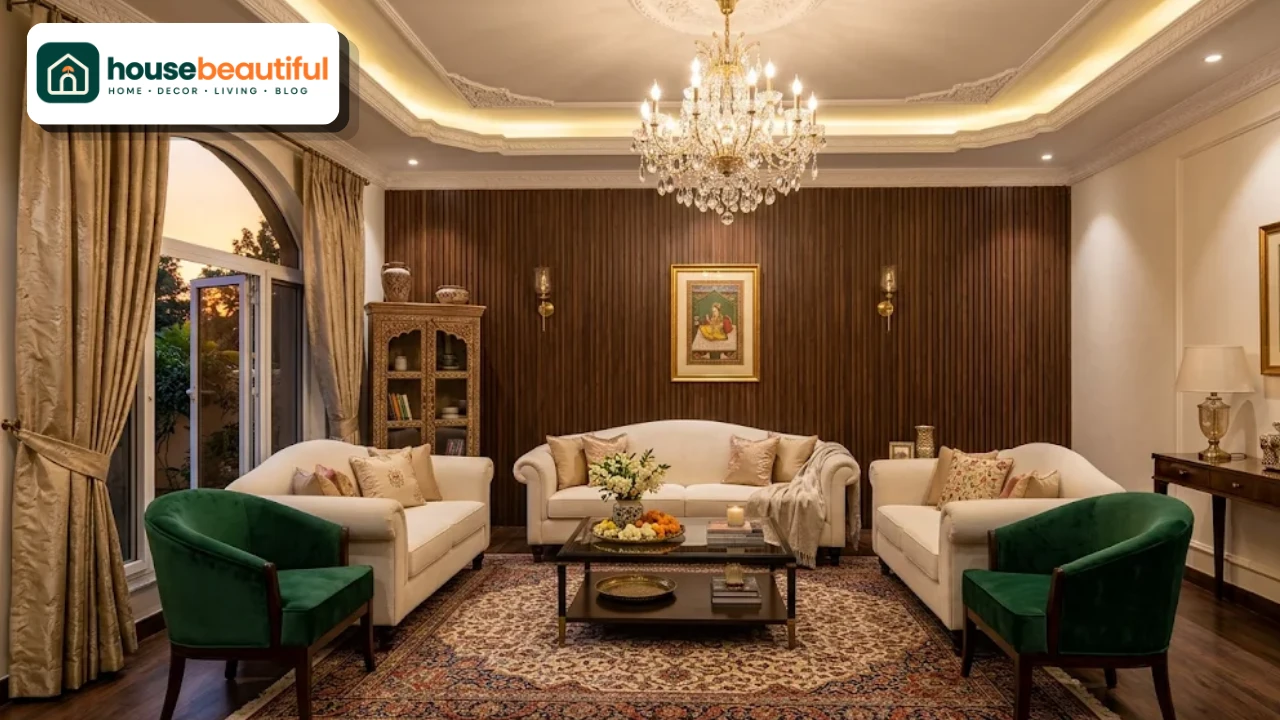
    A chandelier is the classic drawing room centerpiece. Crystal suits traditional and luxury rooms, while sculptural brass or glass pendants suit modern ones. Size it in proportion to the room and the seating group below.

    Layer the lighting

    Combine cove lighting or downlights for general light, table and floor lamps for a warm glow, and accent lights on art or panels. Warm bulbs around 2700K to 3000K make the room welcoming in the evening.

    Put the lights on separate switches and dimmers so the room can be bright for a large gathering and soft for a quiet visit.

    Flooring, Curtains and Rugs

    Flooring

    Marble and marble-look porcelain tiles are popular because they look elegant and stay cool in warm climates. Wood-look tiles and engineered wood bring warmth.

    Whatever you choose, keep it consistent with the rest of the entrance area so the home flows.

    Curtains

    Curtains are one of the most important finishing elements in a drawing room. Hang rods close to the ceiling and let curtains fall to the floor. Layer sheer curtains for daytime with heavier lined curtains in silk, velvet or linen for evenings.

    Rugs

    A large rug ties the seating together and softens a hard floor. Hand-knotted rugs, Persian-style patterns or subtle modern designs all suit drawing rooms. Choose one large enough for at least the front legs of every seat.

    Choosing Furniture Materials and Upholstery

    The materials you choose decide how the drawing room looks after five years, not just on the first day.

    Upholstery fabrics

    Velvet looks rich and suits formal rooms, but it shows marks and needs gentle cleaning. Linen and cotton blends feel relaxed and breathe well in hot weather.

    Performance fabrics resist spills and are ideal if the room is also used by the family.

    Leather is durable and easy to wipe, though it can feel warm in summer. Choose a mid-tone shade such as tan or cognac for a timeless look.

    Wood finishes

    Walnut, teak and sheesham bring warmth and age gracefully. Keep wood tones consistent across the sofa legs, center table, and console, or deliberately contrast one dark and one light tone.

    Metal and glass

    Brass, gold and antique bronze add glamour, while matte black feels modern. Glass-topped tables keep a small room feeling open, but need frequent cleaning.

    Style Directions to Choose From

    Picking one clear style makes every other decision easier. These drawing room interior design ideas cover the most popular directions.

    Modern minimal

    Clean-lined sofas, a neutral palette, hidden storage, and one or two statement pieces. It feels calm and spacious and suits apartments and smaller rooms.

    Classic luxury

    Tufted sofas, a crystal chandelier, molded walls, marble and rich fabrics such as velvet and silk. Keep the palette restrained so the details stand out.

    Contemporary with traditional roots

    Modern furniture mixed with carved wood, brass accents, block-printed cushions, or a jharokha-style mirror. This blend is especially popular in Pakistani and Indian homes because it honors heritage without feeling old-fashioned.

    Mughal-inspired elegance

    Arched niches, jewel tones, intricate patterns, brass lanterns, and rich textiles create a regal, cultural look. Use one or two strong elements rather than covering every surface.

    Art Deco glamour

    Geometric patterns, velvet in deep colors, brass and mirrored surfaces bring a glamorous, evening feel. It works well in rooms used mainly at night.

    Decor and Focal Point Ideas

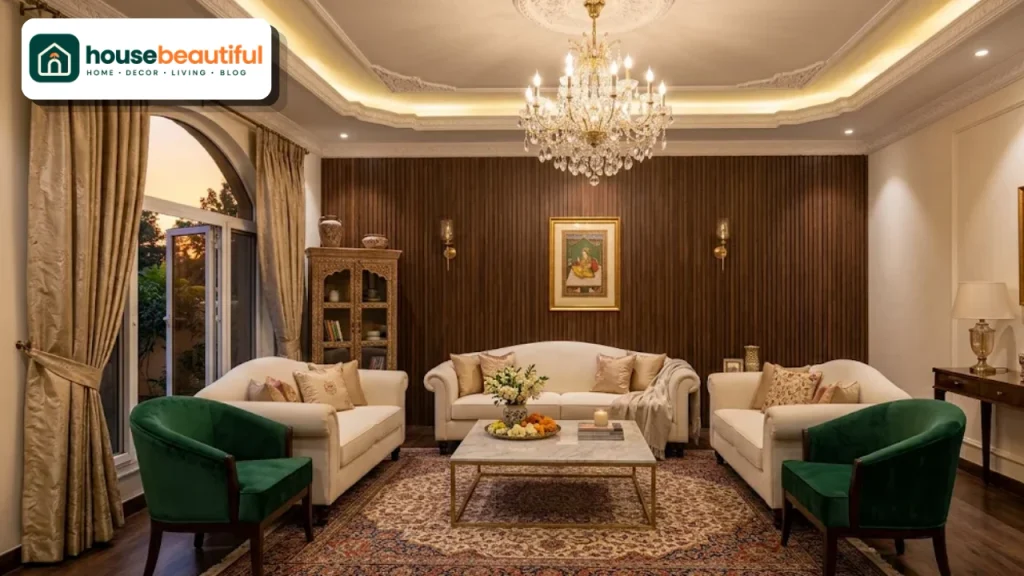
    Drawing room false ceiling with cove lighting and a brass chandelier

    The final layer is what makes the room memorable.

    A console vignette

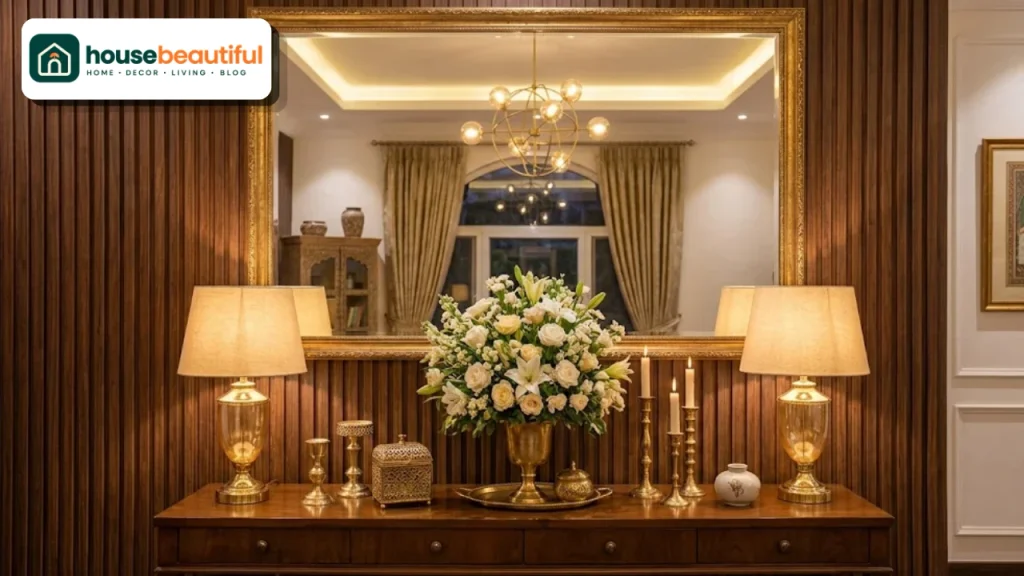
    A console table against the focal wall, topped with a large mirror or artwork, a pair of lamps and a few objects, creates an elegant first impression.

    A showcase or display cabinet

    Many families display fine crockery, silver, awards,s or heirlooms. A glass-front cabinet with internal lighting shows these beautifully. Display fewer items so each one stands out.

    Plants and flowers

    A tall plant in a corner and fresh flowers on the center table add life. Areca palms, snake plan,ts and rubber plants cope well indoors.

    Cushions and throws

    Coordinated cushions are one of the easiest ways to refresh a drawing room for festivals and seasons. Keep two or three main colors and vary textures.

    A Hospitality Corner

    Hospitality is at the heart of a drawing room, so make serving guests easy and elegant.

    A small sideboard or tea trolley near the seating holds trays, cups, a water jug, and snacks. It saves repeated trips to the kitchen and keeps the center table free.

    Include a few side tables so every guest has somewhere to place a cup. Nesting tables are perfect here, because they can be spread out during a visit and stacked away afterward.

    Keep a basket of extra cushions and a couple of folding stools nearby for larger gatherings. When the house fills up during festivals, they make room for everyone without crowding the main seating.

    Festive and Seasonal Styling

    Drawing rooms are where celebrations happen, so plan for easy seasonal changes.

    For Eid, weddings and other festivities, swap in richer cushions, fresh flowers, brass candle holders and fairy lights. A decorative runner on the center table adds instant occasion.

    In summer, lighter cotton cushion covers, sheer curtains and fewer throws keep the room feeling cool. In winter, velvet cushions, a soft throw on each sofa and warmer lamp light make the room inviting.

    Store seasonal items together in labeled boxes, so the room can change in an afternoon.

    Small Drawing Room Ideas

    A small drawing room can still feel grand with the right choices.

    Use light walls, slim-armed furniture on legs, and a glass or slim center table to keep the room visually open. A large mirror opposite a window doubles the light.

    Choose one compact sofa with two light accent chairs instead of a full five-seater set. Nesting tables and ottomans provide extra surfaces and seating when guests arrive, then tuck away.

    Built-in storage along one wall, painted the same color as the walls, keeps the room tidy without adding visual bulk.

    Keep the ceiling simple and use wall lights or a slim pendant instead of a large chandelier. Small drawing room interior design ideas work best when every piece earns its place.

    Large Drawing Room Ideas

    A large drawing room needs zoning so it does not feel empty or echoey.

    Create a main seating group around the focal wall, then add a second area, such as a pair of chairs by the window or a small tea table. Use two rugs to define the zones.

    Bring in larger-scale pieces: a big chandelier, a long console, tall p,lants and large artwork. Soft furnishings such as heavy curtains, upholstered seating and rugs absorb sound and make the room feel warmer.

    In very large rooms, a round or oval table with four chairs in one corner can serve for tea, cards or small family meals. It gives the room a second purpose and makes it feel lived-in rather than staged.

    Comfort, Temperature and Sound

    A drawing room should feel as comfortable as it looks. Guests notice a stuffy, noisy or echoing room even if they cannot say why.

    Plan the AC so cold air does not blow directly onto the main sofa. Ceiling fans should clear any chandelier or pendant comfortably, and both should be on separate switches.

    Hard marble floors and bare walls bounce sound around. A large rug, lined curtains, upholstered chairs and a few cushions soften the acoustics, so conversation feels relaxed rather than echoey.

    Finally, think about smell. Fresh flowers, a discreet diffuser or simply opening the windows before guests arrive keeps the room fresh, especially if it is closed for days between visits.

    Keeping the Drawing Room Guest-Ready

    A drawing room should be ready for unexpected guests without hours of tidying.

    Choose fabrics that resist stains or have removable, washable covers. Mid-tone colors hide dust better than pure white or very dark shades, which matters in dusty climates.

    Give everyday items a home in closed storage so surfaces stay clear. Keep a tray with coasters, tissues,s and a small bowl near the center table, so serving tea is easy.

    Use the room regularly, even when there are no guests. Reading there in the evening or having tea there on weekends keeps the room feeling alive rather than museum-like.

    Budget-Friendly Drawing Room Ideas

    You do not need a large budget to create an elegant drawing room. Some of the most effective drawing room interior design ideas cost little.

    Low-cost changeImpact
    Fresh paint in a warm neutralBrighter, cleaner, more spacious
    New curtains hung high and longRoom looks taller and more formal
    Re-covering the sofa or new cushionsInstantly updated without new furniture
    A large rugTies furniture together
    Two table lampsWarmer, layered evening light
    A large mirrorMore light and a sense of space

    Spend the most on the sofa, the rug, and the lighting, then add decor over time.

    A Step-by-Step Order of Work

    If you are designing a drawing room from scratch, follow this order to avoid redoing finished work.

    Measure the room and plan the layout on paper.

    Finalize electrical points, AC position,n and lighting plan.

    Build the false ceiling and install wiring for lights.

    Finish wall treatments, paneling, and paint.

    Lay or polish the flooring.

    Install curtains, the console, hole, and any built-ins.

    Bring in the sofa, chairs, rug, and center table.

    Finish with lighting fixtures, art, plant,s and decor.

    Following this sequence saves money and stops the most common problem of all: buying a sofa first and then designing the room around it.

    Common Mistakes to Avoid

    Too much furniture. Overcrowding a drawing room with a large sofa set, showca,se and extra tables makes it feel cramped. Leave space to move.

    Every surface decorated. Too many objects look cluttered. Display a few meaningful pieces.

    Overly heavy ceilings. Multi-layered false ceilings with many lights date quickly and can make the room feel low.

    Ignoring comfort. Hard, formal seating keeps guests stiff and families away. Choose comfortable seats with good back support.

    Poor lighting. A single ceiling light makes even a beautiful room flat. Layer your lighting.

    Drawing room console with a mirror, lamps and decor

    FAQs:

    What is the difference between a drawing room and a living room?

    A drawing room is a more formal room for receiving guests, while a living room or family lounge is used for everyday relaxation and watching TV.

    How can I make my drawing room look elegant?

    Use a warm neutral palette, one statement wall, floor-length curtains, a large rug, layered lighting,ing and a few carefully chosen decor pieces.

    What is the best color for a drawing room?

    Warm neutrals such as ivory, b,eige and champagne are timeless. Add rich accents like emerald, navy or burgundy for depth.

    Which sofa is best for a drawing room?

    Facing sofas or an L-shaped sofa with two accent chairs work well. Choose comfortable seating with good back support for guests.

    How do I decorate a small drawing room?

    Use light colors, slim furniture on legs, a large mirror, a glasscoffee, table, and a compact sofa with light accent chairs.

    Should a drawing room have a TV?

    A dedicated guest drawing room usually works best without one. If the room doubles as a family lounge, frame the TV within a paneled wall or cabinet.

    Which false ceiling is best for a drawing room?

    A slim gypsum peripheral ceiling with cove lighting suits most rooms. Taller ceilings can take a two-level tray design.

    What lighting suits a drawing room?

    Combine a statement chandelier or pendant with cove lights, table lamps, and accent lights. Warm bulbs around 2700K to 3000K feel welcoming.

    How can I design a drawing room on a budget?

    Repaint, update curtains, add a larger rug, re-cover or refresh the sofa with new cushions, and add lamps and a mirror.

    What curtains suit a drawing room?

    Floor-length curtains in silk, velvet or linen, layered with sheers, hung close to the ceiling for a taller, more formal look.