
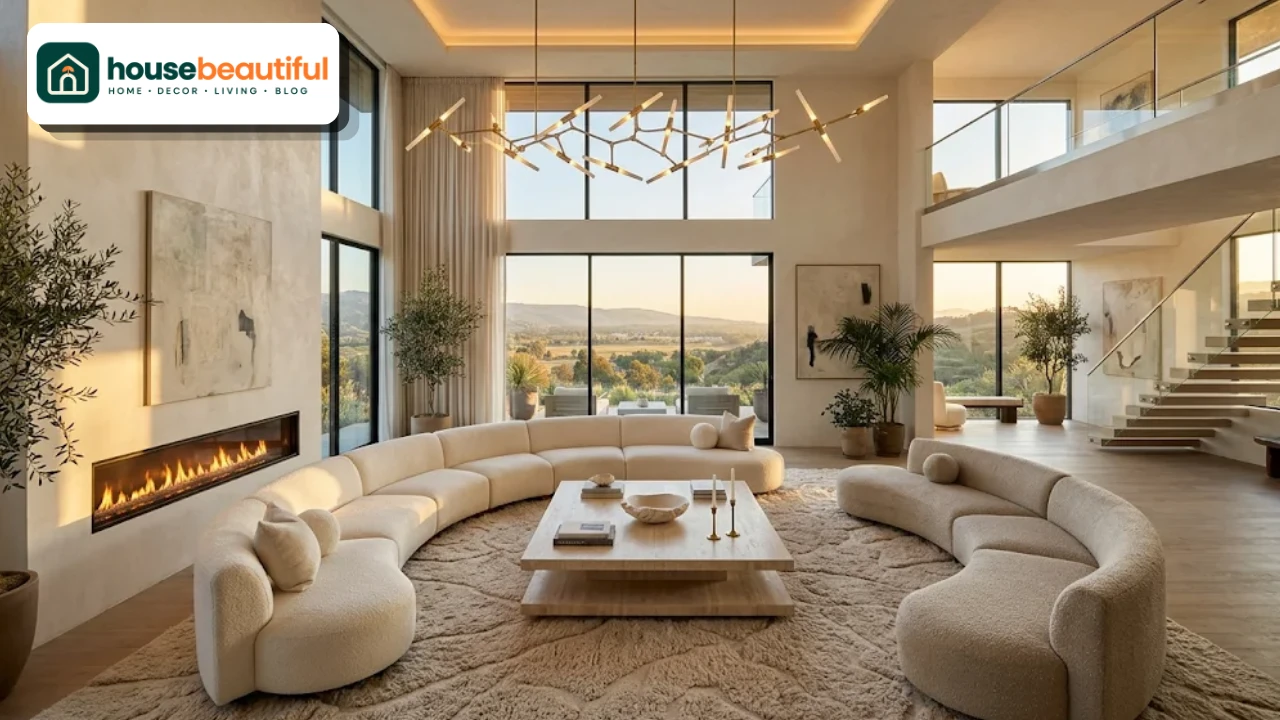
A big living room sounds like a dream. Then the furniture arrives, and somehow the room still looks half-empty.
The sofa floats in the middle of the floor. Voices echo off the walls. The beautiful high ceiling makes everything below it look small, and the room feels more like a hotel lobby than a place to curl up with a book.
This is the most common problem with a large contemporary living room, and it has nothing to do with taste. It is about scale, zoning, light and texture.
This guide explains how designers handle each one, so your big room feels generous, calm and genuinely lived-in.
What Does Contemporary Mean in a Living Room?
Contemporary design simply means the style of the present moment. It changes over time, which is why it is often confused with modern design.
Modern design refers to a specific historic movement from the early and mid-twentieth century, with its clean lines and functional furniture.
Contemporary design borrows from it but stays current, absorbing new materials, colors, and shapes.
Today, contemporary living rooms tend to share a few traits: clean architecture, a calm and often warm neutral palette, a mix of natural materials, curved or sculptural furniture, generous natural light, and very little clutter.
In a large room,m these traits are an advantage. Clean lines and a restrained palette stop a big space from feeling chaotic. The challenge is keeping it warm.
The Big-Room Challenge
Large living rooms fail in predictable ways. Understanding them makes the solutions obvious.
Furniture that is too small. Standard sofas and rugs look lost in a big room, leaving islands of furniture in a sea of floor.
Everything against the walls. Pushing furniture to the edges leaves a huge empty middle and makes conversation difficult.
One overhead light. A single fixture cannot light a large volume well, so the room feels dim in the corners and flat everywhere else.
Hard surfaces everywhere. Large windows, stone or tile floors,s and bare walls bounce sound around, creating echo.
No sense of purpose. A big room with one sofa and a TV wastes its potential. Large rooms work best when they do more than one thing.
Every idea that follows addresses one or more of these problems.
Zoning: The Secret to a Large Living Room
The single most important idea for any large contemporary living room is zoning. Instead of treating the room as one space, divide it into two or three smaller areas, each with its own purpose.
Choose your zones
Most large living rooms have room for a main conversation or TV zone plus one or two secondary areas. Popular secondary zones include a reading corner, a small game or tea table, a home office nook, a bar area, a piano or a play space.
Think about how your household spends its evenings and weekends. The zones should match real habits, not a magazine photo.
Anchor each zone with a rug
A rug is the easiest way to define a zone. Give the main seating area a large rug, then use a smaller rug for a reading corner or dining area.
The rugs do not need to match, but they should relate in color or texture so the room still feels unified.
Use furniture as walls
The back of a sofa makes an excellent low divider. A slim console table behind it adds a surface for lamps and books while signaling the edge of the seating zone.
Open shelving units, a pair of tall plants or a low bench can also separate areas without blocking light.
Use light to define space
A pendant hung over a tea table, a floor lamp marking a reading chair, or a cluster of lights over a bar area all help each zone feel like a distinct place.
Layout Ideas for a Large Contemporary Living Room
Once you know your zones, choose a layout for the main seating area. These three work especially well in big rooms.
The conversation square
Place a large sofa facing two armchairs, with a second sofa or a bench closing the square. A big coffee table in the middle completes the arrangement.
This layout feels sociable and intentional, and it works even without a TV.
The oversized sectional
A large L-shaped or U-shaped sectional with a pair of armchairs opposite creates a generous lounging area. Float it in the room rather than pushing it into a corner.
Modular sectionals are ideal because they can be reconfigured as needs change.
Facing sofas around a fireplace
Two identical sofas facing each other, perpendicular to a fireplace or focal wall, create symmetry and calm. Add a pair of chairs at the open end for extra seating.
Keep comfortable distances
Even in a large room, seating should stay close enough for conversation. The room may be big, but the conversation group should feel intimate.
Furniture Ideas for a Large Contemporary Living Room
The right furniture does most of the work in a large contemporary living room. Look for pieces with presence, clean lin,es and a mix of shapes.
Curved and sculptural seating
Curved sofas and rounded accent chairs are a defining contemporary look. In a big room, a curved sofa softens hard architecture and naturally creates a sociable, enclosed seating area.
Low, deep sofas
Low-slung, deep-seated sofas feel relaxed and modern. They also keep sightlines open across a large room, so the space still feels airy.
Statement accent chairs
A pair of sculptural chairs in leather, bouclé,cle or velvet adds personality. In a large room, chairs can be slightly bigger and bolder than usual.
Substantial tables
Choose a large coffee table in stone, wood or travertine, or group two smaller tables together. Add side tables beside every seat so guests always have somewhere to put a drink.
Benches and ottomans
A long upholstered bench or a pair of large ottomans provide flexible extra seating and can close off a conversation square without blocking views.
Getting the Scale Right
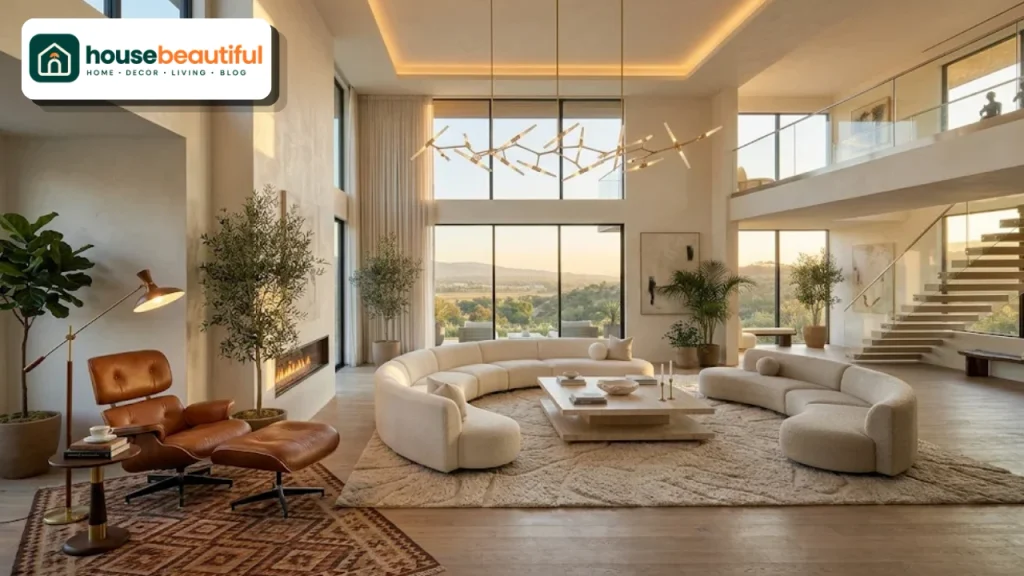
Scale is where most large rooms go wrong. Oversize your key pieces and the room immediately looks more finished.
| Element | Guideline for a large room | Why it matters |
|---|---|---|
| Main rug | Large enough for all seating legs to sit on it; often 10 x 14 ft or larger | Pulls the group together |
| Sofa or sectional | Generous length and depth; consider a sectional | Matches the room’s proportions |
| Coffee table | About two-thirds the length of the sofa | Keeps it reachable and in proportion |
| Sofa to coffee table | About 16 to 18 inches | Easy to reach without crowding |
| Seats facing each other | About 8 to 10 feet apart | Comfortable conversation distance |
| Art above sofa | About two-thirds the sofa width | Avoids the “postage stamp” effect |
Large rooms can also take larger single pieces: a big sculptural coffee table, oversized art, a tall arc ,lamp, or a substantial bookcase. A few big items look calmer than many small ones.
Colors for a Large Contemporary Living Room
Color can make a big room feel warmer and more connected.
Warm neutrals
Contemporary rooms often start with warm whites, greige, sand, mushroom,m and soft taupe. Warmer neutrals have largely replaced cool grays, and they make a large space feel inviting rather than stark.
Deeper accent walls
A large room can carry darker colors without feeling closed in. A deep olive, charcoal, ink blue, or chocolate brown on one wall, or on a media wall, adds depth and makes the space feel more intimate.
A restrained palette
Choose two or three main colors and repeat them across zones. Repetition is what makes a big room feel like one design rather than separate pieces.
Color drenching
For a cocooning effect, paint walls, trim,m and even the ceiling in the same color. It works beautifully in a large room with high ceilings, softening the volume.
Materials and Textures
Texture is what makes a contemporary room feel warm instead of cold.
Mix natural materials: oak or walnut wood, stone or marble, plaster walls, linen and wool upholstery, boucle chairs, leather cushions and jute or wool rugs. Each adds a different surface for the eye.
Contemporary rooms often use matte finishes, brushed brass, matte black metal and natural stone. Combining a few of these creates depth without clutter.
Limewash or textured plaster walls are particularly effective in big rooms. They catch light across a large surface and make walls feel soft and rich rather than flat.
Focal Points: Fireplace, TV and Art
A large room needs a strong focal point, or the eye has nowhere to rest.
Contemporary fireplaces
A long, linear ribbon fireplace set into a plaster, stone or concrete wall is a signature contemporary feature. A two-sided fireplace can also act as a divider between zones.
Keep the surround simple and let the material speak.
Media walls
If the TV is central to the room, design a media wall around it. Built-in shelving, slatted wood panels,ls or a dark painted wall can frame the screen so it blends into the design instead of dominating it.
Many large contemporary rooms combine a fireplace and TV on the same wall. Keep the TV at a comfortable viewing height rather than high above the fireplace if possible.
Oversized art
A single large artwork or a pair of matching canvases makes a confident statement in a big room. Sculpture on a plinth or a large ceramic piece works too.
Flooring Choices
Flooring covers more area in a big room than any other surface, so it shapes the whole look.
Wide-plank oak or engineered wood brings warmth and suits most contemporary styles. Large-format porcelain or stone-look tiles create a seamless, minimal surface and stay cool in warm climates.
Polished concrete and microcement give an architectural, gallery-like feel, but they need large rugs to soften both the look and the acoustics.
Whatever you choose, run it continuously through connected spaces. Fewer transitions make a large area feel calmer and more expansive.
Storage and Built-Ins
Clutter is very visible in a big, minimal room, so storage matters even more.
Built-in cabinetry along one wall, with closed lower cupboards and open shelves above, gives a large contemporary living room a tailored, architectural look. Flat-front, handleless doors keep the lines clean.
A long, low media unit can stretch across a whole wall, housing electronics, games and everyday items while providing a surface for art and objects.
Hidden storage inside ottomans, benches and coffee tables keeps throws, remotes and chargers out of sight.
Styling Shelves and Surfaces
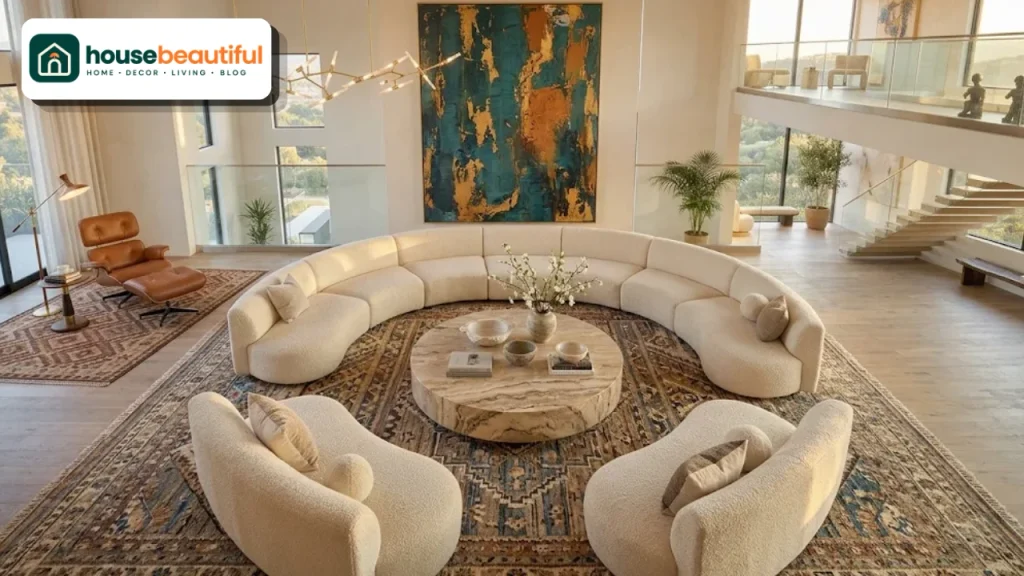
In a contemporary room, styling is about restraint. Each surface should look considered, not crowded.
Group objects in odd numbers and vary their height and shape. Mix books laid flat and upright, ceramics, a small plant, and one or two personal pieces.
Leave empty space on every shelf. In a large room, negative space looks intentional and calm.
On the coffee table, a large tray, a stack of books, and a vase with branches or flowers are usually enough.
Lighting a Large Living Room
Lighting a large room well takes more sources than most people expect.
Start with ambient lighting: recessed lights, cove lighting, or a large statement pendant. In very big rooms, use more than one ceiling fixture so the light is even.
Add task lighting with floor and table lamps beside seats, especially in reading corners. Then layer in accent lights: picture lights over art, LED strips in shelving,g and wall sconces.
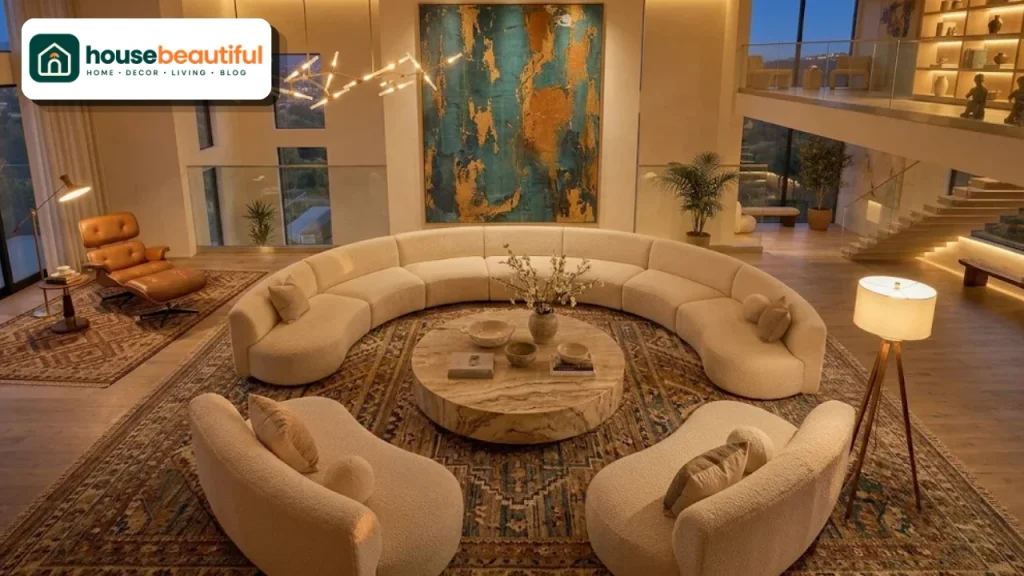
A large sculptural pendant or a cluster of pendants over the seating area can define the main zone and act as art in its own right.
Put each zone on separate switches and use dimmers. Warm bulbs around 2700K help a large space feel cozy in the evening.
Ceilings and Windows
High and vaulted ceilings
Tall ceilings are beautiful but can make furniture look small. Bring the eye down with a large pendant, tall bookshelves, oversized art, or exposed beams.
Painting the ceiling a warm shade, or adding wood paneling to it, makes a tall room feel more intimate.
Floor-to-ceiling windows
Large windows are a highlight of many contemporary rooms. Dress them with floor-length sheer curtains on a ceiling track to soften the glass without blocking light.
Motorized blinds or curtains are practical for very large windows, and they help manage heat, glare and privacy.
Connecting Indoors and Outdoors
Many large contemporary living rooms open onto a terrace, garden or balcony through wide sliding or folding doors. Treating the two spaces as one makes the room feel even bigger.
Use a similar color palette and materials inside and out, such as matching stone tones or the same wood. Position the main seating so it enjoys the view, rather than turning its back on the garden.
Large pots with trees or tall grasses just outside the glass extend the green into the room. At night, soft outdoor lighting stops the windows from turning into black mirrors and keeps the view alive after dark.
Making a Large Room Feel Cozy
A big room does not have to feel cold. These ideas bring warmth and intimacy.
Group seating closely, even if the room is large. Add plenty of soft furnishings: cushions, throws, upholstered chairs,s and a deep-pile or wool rug.
Bring in plants, especially large ones such as fiddle-leaf figs, olive trees or bird of paradise. They fill vertical space and soften hard lines.
Use warm lighting at multiple heights, and avoid bright overhead light in the evening.
Managing Acoustics
Echo is one of the biggest complaints in large contemporary rooms. Hard floors, windows,ws and minimal furniture all reflect sound.
Large rugs, upholstered furniture, heavy curtains and full bookshelves absorb sound. Fabric wall panels or slatted wood panels with acoustic backing can be both decorative and functional.
Even a few large cushions and a fabric-covered headboard-style panel behind the sofa make a noticeable difference.
Living With Kids and Pets
A large contemporary living room can look sleek and still handle family life. The key is choosing finishes that forgive.
Performance fabrics, washable slipcovers and leather resist spills and claws better than delicate linen or silk. Mid-tone upholstery hides marks far better than pure white.
Rounded coffee tables and curved furniture are safer for small children, and they suit the contemporary look perfectly. A flat-weave or low-pile wool rug is easier to clean than a shaggy one.
Use the extra space to your advantage. A secondary zone with low shelves, a soft rug and storage baskets can become a play corner that is easy to tidy away when guests arrive.
Seasonal Styling
Contemporary rooms rely on a calm base, which makes seasonal updates easy.
In warmer months, use light linen cushions, sheer curtains drawn back, fewer throws and plenty of greenery. Let the large windows do the work.
In cooler months, layer wool and boucle throws, velvet cushions and a thicker rug in the seating zone. Add candles and more lamp light to make the large volume feel snug.
Keep these changes to textiles and accessories. The main furniture and palette stay the same, so the room always feels cohesive.
Open-Plan Large Living Rooms
Many large contemporary living rooms are part of an open-plan space with the kitchen and dining area.
Use the same flooring throughout to keep the space connected, and define the living area with a rug and the back of the sofa.
Repeat materials across zones, such as the same wood in the coffee table and dining table, or matching metal finishes on lighting. This keeps a big open space feeling like one home.
Where to Spend and Where to Save
Furnishing a big room can be expensive, so prioritize the pieces that define it.
| Spend more on | Save on or add later |
|---|---|
| A large, comfortable sectional or sofa | Side tables and small accent pieces |
| An oversized rug | Cushions and throws |
| Lighting and dimmers | Decorative objects |
| Built-in storage or a media wall | Secondary zone furniture |
| One statement artwork or pendant | Plants, which can grow into the space |
Furnishing in stages is perfectly fine. Start with the main zone, live in it for a while, then add secondary areas as you understand how you use the room.
A Step-by-Step Plan
If you are starting from scratch, this order keeps a large contemporary living room project on track.
Measure the room and mark windows, doors, power poi,nts and the focal wall.
Decide your zones and sketch a layout for each.
Plan lighting circuits, sockets and any media wall wiring.
Choose flooring and wall finishes.
Buy the main sofa or sectional and the main rug.
Add coffee table, accent chairs and side tables.
Furnish secondary zones.
Finish with art, plants, textiles, tiles,iles and accessories.
Common Mistakes to Avoid
Undersized furniture and rugs. Scale up the key pieces so the room feels finished.
Furniture pushed against the walls. Float seating and create zones instead.
Single-source lighting. Use many light sources at different heights.
Too many small decor items. Choose fewer, larger pieces for a calmer look.
Ignoring texture. A contemporary room with no texture feels cold. Mix wood, stone, wool a,nd linen.
FAQs:
How do I arrange furniture in a large living room?
Divide the room into zones, float the main seating away from the walls, anchor each area with a rug,nd keep seats within conversation distance.
How can I make a large living room feel cozy?
Use zoning, warm lighting at several heights, soft textures, large rugs, plants a,nd closely grouped seating.
What size rug do I need for a large living room?
Choose a rug big enough for all seating legs to rest on it. In large rooms, this is often 10 by 14 feet or larger.
What is the difference between contemporary and modern design?
Modern design refers to a specific mid-twentieth-century movement. Contemporary design reflects current trends and changes over time.
What colors work best in a large contemporary living room?
Warm neutrals as a base, with broader accents such as olive, charcoal,arcoal or navy on a feature wall.
How do I fill empty space in a large living room?
Add secondary zones such as a reading corner or tea table, use oversized furniture and art, and bring in large plants.
Where should the TV go in a large living room?
On a media wall or focal wall facing the main seating group, ideally at seated eye level rather than high above a fireplace.
How do I stop echo in a big living room?
Add large rugs, upholstered furniture, heavy curtains, bookshelves, and acoustic panels.
What lighting is best for a large living room?
Layer ambient, task, and accent lighting with several ceiling fixtures and wall lights, all on dimmers.
Can a large living room have more than one seating area?
Yes. Many large rooms work best with a main seating group and a smaller secondary area for reading, games, or conversation.